For a long time, education could reasonably assume that producing an answer was evidence of knowing how to produce that answer.
That assumption is disappearing.
AI can already write an essay, solve an equation, summarize a chapter, translate a text, explain a historical event, generate code, and answer questions across almost every school subject.
And it will get better.
This means education cannot simply defend the old desired state by trying to prevent students from using AI.
The desired state itself has to evolve.
The important question is no longer:
Can the student produce this answer?
Increasingly, it becomes:
What can the student understand, evaluate, question, connect, and do—even when intelligent tools are available?
That is a profound change.
The Value of Producing an Answer Is Falling
When information was difficult to access, remembering information had enormous practical value.
When finding information became easy, knowing how to find and evaluate it became increasingly important.
Now we are entering another transition.
Producing an answer is becoming cheap.
Producing a plausible answer is becoming almost effortless.
But understanding whether that answer makes sense remains valuable.
Knowing what question to ask remains valuable.
Recognizing that something is missing remains valuable.
Connecting information to existing knowledge remains valuable.
Applying knowledge in a new situation remains valuable.
And perhaps most importantly, knowing when you do not understand something remains valuable.
AI does not eliminate the need for learning.
It changes what we should optimize learning for.
This Creates a New Problem for Assessment
Imagine two students submit equally excellent answers.
The first student understands the subject deeply.
The second student copied an AI-generated answer they barely understand.
The observable output may be almost identical.
The internal state of the learners is completely different.
If our education system measures primarily the output, it may struggle to distinguish between them.
This is why AI makes the distinction between performance and learning increasingly important.
We cannot assume that a polished output represents a polished understanding.
Assessment therefore needs to become more diagnostic.
Instead of only asking whether the final answer is correct, we should increasingly ask:
- What does the student understand?
- Where does their understanding break down?
- Which prerequisite is missing?
- Can they explain the concept differently?
- Can they apply it in an unfamiliar situation?
- Can they recognize when an answer is wrong?
- And what should they learn next?
These questions are much closer to measuring the actual state of the learner.
AI Can Also Help Solve the Problem It Creates
There is an interesting paradox here.
AI makes traditional assessment more difficult.
But AI can also make much more sophisticated assessment possible.
A traditional test might tell us that a student answered six out of ten questions correctly.
An intelligent learning system can potentially go further.
It can examine which questions were wrong.
It can look for patterns.
It can test prerequisite knowledge.
It can ask a different question about the same concept.
It can increase or decrease difficulty.
It can distinguish between a careless mistake and a fundamental misunderstanding.
And it can use that information to decide what the learner should encounter next.
The result is something education has always wanted but has found difficult to provide at scale:
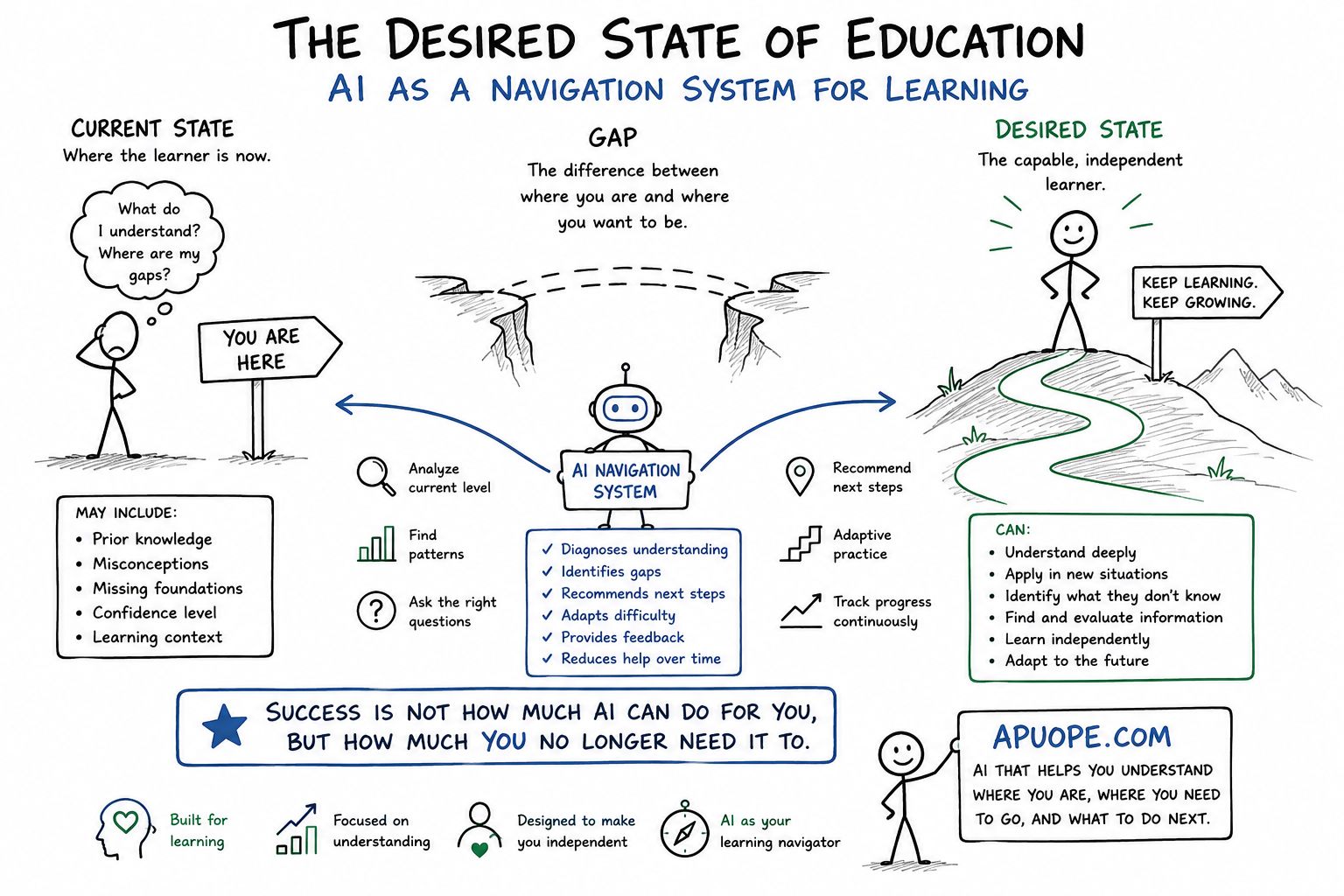
continuous feedback about the gap between the learner's current state and desired state.
That is where AI becomes genuinely interesting for education.
Not as an answer machine.
As a navigation system.
From Content Delivery to Learning Navigation
For decades, educational technology has concentrated heavily on delivering content.
Digital textbooks.
Videos.
Online courses.
Learning management systems.
Question banks.
All of these can be useful.
But access to content is rapidly becoming one of the least difficult parts of learning.
AI can explain almost anything in seconds.
The harder questions are becoming:
What should I learn next?
What am I missing?
Why don't I understand this?
Am I actually improving?
What should I practise?
When am I ready to move forward?
These are navigation problems.
And solving them requires knowing two things:
Where are you now?
and
Where are you trying to go?
Everything between those two points is the learning journey.
The Desired State Is No Longer Static
There is another consequence.
The desired state itself will keep changing.
Students entering school today will eventually work in a world where AI capabilities are dramatically different from those available when their curriculum was designed.
Specific tools will change.
Some skills will become less valuable.
Others will become more important.
Entire professions will change.
So education cannot prepare students only for a predefined collection of tasks.
It has to prepare them for environments we cannot completely predict.
That makes the ability to learn increasingly important.
A student who knows today's answers may be well prepared for today's exam.
A student who knows how to identify what they do not know, acquire new knowledge, test their understanding, and adapt is better prepared for what comes afterwards.
That may be one of the most important desired states education can pursue.
Where APUOPE Fits
This is the problem we are trying to explore with APUOPE.
Not:
How can AI do schoolwork faster?
But:
How can AI help someone become better at learning?
That distinction determines almost everything.
Instead of treating the generated answer as the end product, the system should treat the learner's changing state as the product.
A student uploads material.
The important question is not how quickly AI can summarize it.
The important question is what the student already understands about it.
Where are the gaps?
Which concepts are foundational?
What should be practised first?
What has already been mastered?
What should become harder?
And when should the system stop helping?
The purpose of AI should not be to remove productive difficulty from learning.
It should help place that difficulty in the right place.
Too easy, and little changes.
Too difficult, and the learner gets lost.
The interesting territory lies between them.
That is where understanding grows.
The Future of Educational AI Should Not Be About Better Answers
There will be plenty of systems capable of generating better answers.
That race is already happening.
Education has a different opportunity.
Build systems that create better learners.
Systems that understand that a wrong answer can be useful information.
Systems that do not confuse completing an assignment with understanding its content.
Systems that continuously estimate where the learner is and adapt what happens next.
Systems where AI gradually gives less help as the learner becomes more capable.
Because the ultimate success of educational AI should not be measured by how much the AI can do for the student.
It should be measured by how much the student eventually no longer needs the AI to do for them.
That is the direction behind APUOPE.COM.
We are not trying to build an AI that learns instead of you.
We are trying to build one that helps you understand where you are, where you need to go, and what you should do next.
Because in a world where answers are becoming almost free, knowing how to learn may become more valuable than ever.