Many study apps feel good to use.
They are colorful. They are smooth. They reward you quickly. They show progress bars, streaks, badges, points, animations and encouraging messages.
And because of that, they can make you feel like you are learning.
But there is a problem.
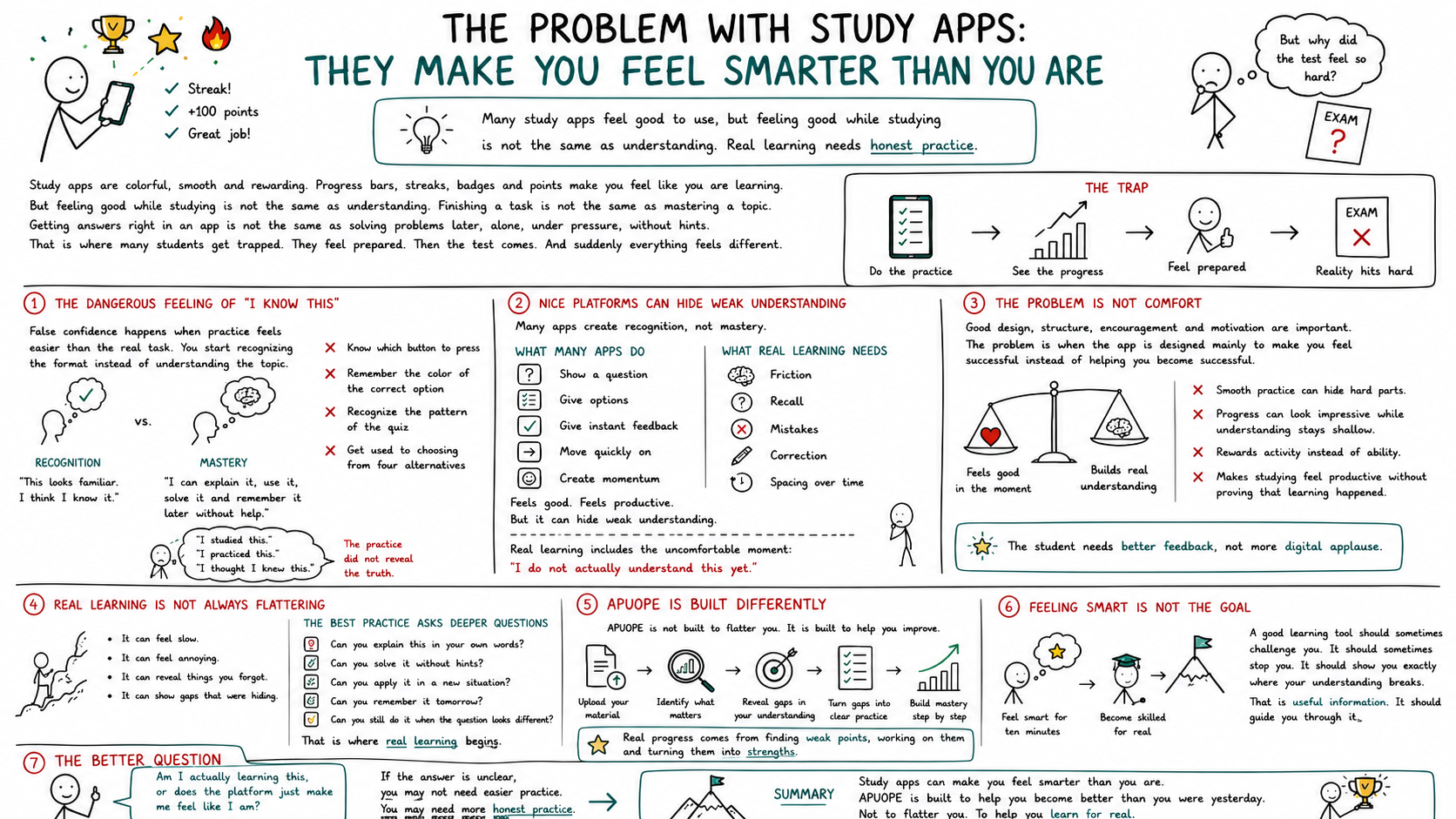
Feeling good while studying is not the same as understanding. Finishing a task is not the same as mastering a topic. Getting answers right inside an app is not the same as being able to solve the problem later, alone, under pressure, without hints.
That is where many students get trapped.
They do the practice. They see the progress. They feel prepared.
Then the test comes.
And suddenly everything feels different.
The dangerous feeling of “I know this”
One of the most dangerous feelings in learning is the feeling that you already know something.
Not because confidence is bad.
Confidence is important.
But false confidence is dangerous.
False confidence happens when practice feels easier than the real task. It happens when the platform gives you too many hints, too many visual clues, too much structure or too many small rewards. The student starts to recognize the format instead of understanding the topic.
They are not always learning the subject.
Sometimes they are learning the app.
That is a very different thing.
A student may know which button to press. They may remember the color of the correct option. They may recognize the pattern of the quiz. They may get used to choosing from four alternatives.
But when the same topic appears in a real exam, in a different form, with no hints and no friendly design helping them, the weakness appears.
That moment can feel brutal.
“I studied this.”
“I practiced this.”
“I thought I knew this.”
And they are not lying.
They really did feel like they knew it.
The problem is that the practice did not reveal the truth.
Nice platforms can hide weak understanding
A good learning tool should not only make studying pleasant.
It should make learning honest.
That means it should help students discover what they actually understand and what they only recognize when the environment is helping them.
There is a big difference between these two:
Recognition:
“This looks familiar. I think I know it.”
Mastery:
“I can explain it, use it, solve it and remember it later without help.”
Many study apps are very good at creating recognition.
They show a question. They give options. They give instant feedback. They move quickly to the next task. The student feels momentum.
But real mastery needs more than momentum.
It needs friction. It needs recall. It needs mistakes. It needs correction. It needs the uncomfortable moment where the student realizes, “I do not actually understand this yet.”
That moment is not failure.
That moment is the beginning of real learning.
The problem is not comfort
The problem is not that learning platforms look good.
Good design matters. Clear structure matters. Encouragement matters. Motivation matters.
A boring, confusing or ugly platform does not automatically create better learning.
The problem starts when the platform is designed mainly to make the student feel successful instead of helping them become successful.
There is a difference.
A platform can make practice feel smooth while hiding the hard parts. It can make progress look impressive while the student’s real understanding remains shallow. It can reward activity instead of ability. It can make studying feel productive without proving that learning has actually happened.
That is the trap.
The student does not need more digital applause.
The student needs better feedback.
Real learning is not always flattering
Real learning does not always feel smooth.
Sometimes it feels slow. Sometimes it feels annoying. Sometimes it reveals that you forgot something you thought you knew. Sometimes it shows that you can solve the easy version but not the harder version. Sometimes it exposes a gap that has been hiding for weeks, months or even years.
That can feel uncomfortable.
But it is also useful.
Because once the gap is visible, it can be fixed.
You cannot improve what you cannot see.
This is why honest practice matters. The best kind of practice does not simply ask, “Can you click the right answer?”
It asks deeper questions.
- Can you explain this in your own words?
- Can you solve it without hints?
- Can you apply it in a new situation?
- Can you remember it tomorrow?
- Can you still do it when the question looks different?
That is where real learning begins.
APUOPE is built differently
APUOPE is not built to flatter you.
It is built to help you improve.
The goal is not to make studying feel easier than it really is. The goal is to help you find the right difficulty, at the right time, from the material you actually need to learn.
You upload your learning material. APUOPE helps identify what matters. It reveals gaps in your understanding. It turns those gaps into clear practice. It helps you build mastery step by step.
Not by pretending everything is easy.
But by helping you face the right challenge.
That is important because real progress does not come from avoiding weak points. It comes from finding them, working on them and turning them into strengths.
Feeling smart is not the goal
The goal of studying is not to feel smart for ten minutes.
The goal is to become skilled for real.
That means practice should sometimes challenge you. It should sometimes stop you. It should sometimes show you exactly where your understanding breaks.
That is not a bad thing.
That is useful information.
A good learning tool should not protect you from that moment. It should guide you through it.
Because the moment you realize what you do not understand is often the moment real learning can finally begin.
The better question
So the next time a study app makes you feel like you are doing great, ask one simple question:
Am I actually learning this, or does the platform just make me feel like I am?
If the answer is unclear, you may not need easier practice.
You may need more honest practice.
That is what APUOPE is built for.
Not to make you feel smarter than you are.
But to help you become better than you were yesterday.