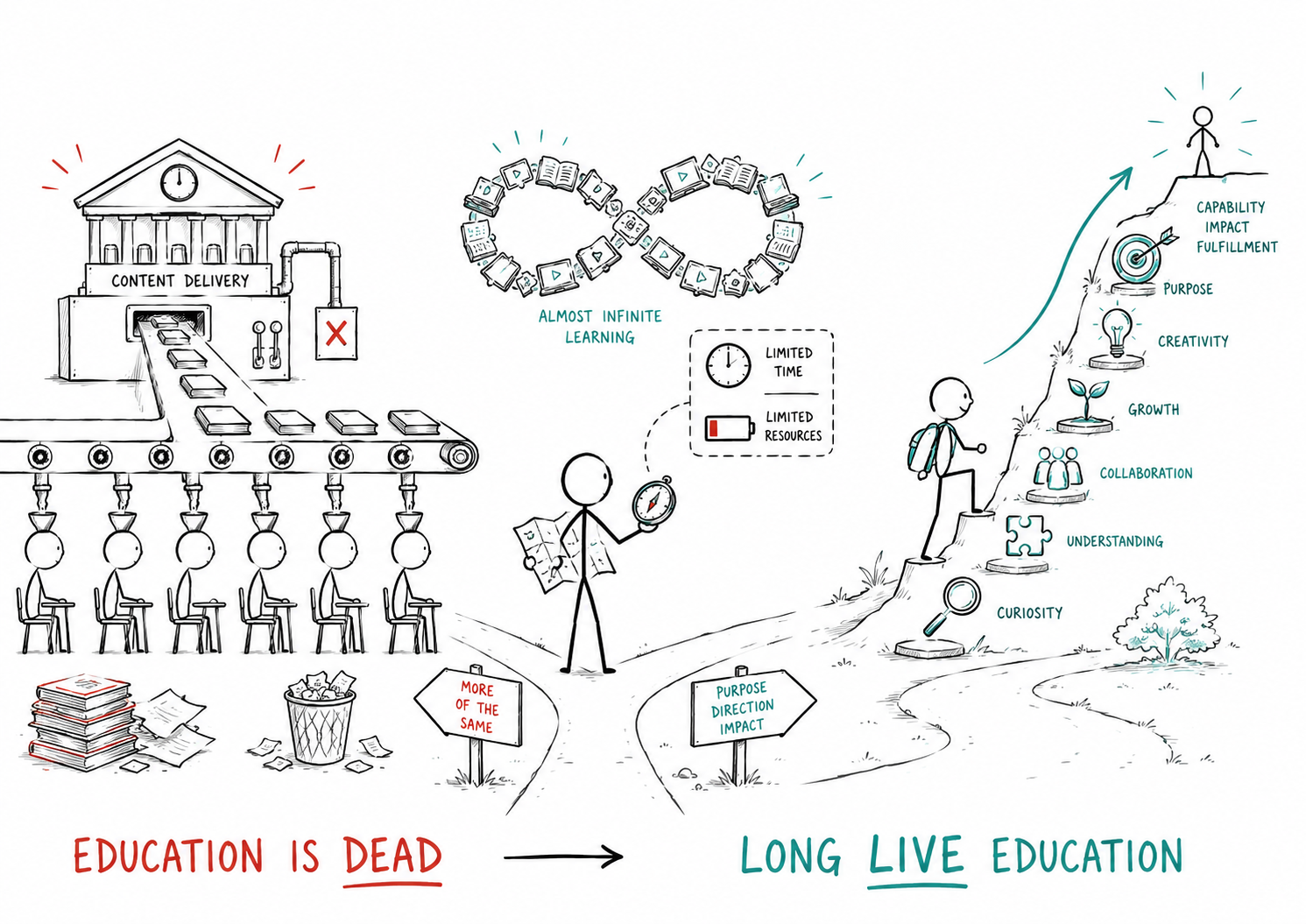
Education as content delivery is dying. Education as human development is just getting started.
For a very long time, education had a simple and powerful advantage: access. Schools had the books, teachers had the knowledge, and universities had the experts. If you wanted to learn something difficult, you usually needed access to an institution, a library, a course, or a person who knew more than you did.
That made information valuable partly because it was scarce. Today, that scarcity is disappearing at remarkable speed. A student can ask an AI system to explain a difficult concept in five different ways, generate examples, simplify the language, translate the material, create practice questions, test understanding, give feedback, and repeat the entire process as many times as necessary.
All of this can happen instantly. That changes something fundamental.
If the primary value of education is delivering information from someone who has it to someone who does not, then a significant part of the traditional education model is becoming difficult to defend. But that does not mean education is becoming less important. It means we may finally have to become much clearer about what education is actually for — and where its value comes from.
Content Delivery Was Never the Whole Point
We often talk about education and learning as though they were interchangeable. They are not. A lesson can be delivered without being understood. A textbook can be read without being remembered. An assignment can be completed without creating meaningful competence. A student can pass an examination and discover six months later that very little remains.
Education systems are exceptionally good at measuring whether educational activities happened: whether the student was present, whether the assignment was submitted, whether the course was completed, whether the examination was passed, and whether the qualification was awarded. These are useful measures, but they are not the same as asking whether the student actually became more capable.
That distinction matters more now than ever. When access to explanations, information, and educational content becomes almost unlimited, simply providing more content creates less and less unique value.
The scarce resource is shifting. The difficult part is no longer necessarily finding an explanation. The difficult part is knowing what you need to understand, recognizing what you do not understand, connecting new knowledge to old knowledge, practicing until understanding becomes usable competence, and continuing when the process becomes frustrating.
Those are not primarily content problems. They are human problems. And that is where the future of education becomes much more interesting.
Value Is Not Only Created. It Has to Be Perceived.
There is another problem education often ignores: something can have enormous long-term value and still feel almost worthless to the person experiencing it.
A fourteen-year-old may genuinely benefit from understanding algebra, history, chemistry, writing, or statistics. The value may become obvious years later when those skills unlock further education, improve decision-making, make a career possible, or simply make the world easier to understand. But none of that automatically means the student can see the value today.
And perceived value matters.
A student sitting in a classroom is constantly making an implicit calculation. Why am I doing this? Is this useful? Am I getting better at it? Will I ever need this? Can I succeed? Is the effort worth it? What happens if I stop trying?
If education cannot provide credible answers to those questions, the problem is not necessarily that the student is lazy or unmotivated. The student may simply perceive the exchange as poor. They are giving their time, attention, effort, autonomy, and often emotional energy to something whose value they cannot clearly see.
Adults would react exactly the same way. If an employee were asked to spend hundreds of hours doing work whose purpose was unclear, whose results were invisible, and whose relevance might only become apparent ten years later, we would not be surprised if motivation declined. Yet in education, we often treat the same response as a character flaw.
Sometimes disengagement really is a motivation problem. Sometimes it is a discipline problem. But sometimes it is a value perception problem.
Real Value and Perceived Value Are Not the Same Thing
This distinction is critical. Education can create real value even when the learner does not immediately recognize it. Likewise, education can feel valuable without creating much lasting value.
A highly entertaining lesson may produce excellent engagement while leaving little durable knowledge behind. A difficult exercise may feel frustrating and inefficient while creating exactly the kind of retrieval strength, persistence, and understanding that matters later.
So the goal cannot simply be to maximize perceived value by making everything easier, more entertaining, or immediately rewarding. That would be just another form of optimization failure. The real challenge is to reduce the gap between actual value and perceived value.
Students should increasingly understand what they are learning, why it matters, what capability it is building, how it connects to what they already know, and how their effort is producing progress. That does not mean every lesson needs to be turned into entertainment. It means education should become better at making value visible.
There is a huge difference between telling a student, “You need to learn this because it is on the exam,” and telling them, “Almost everything we do next depends on this. You already understand two of the four pieces. Once these two gaps are fixed, the next topic becomes much easier.” The educational content may be identical. The perceived value is not.
When Education Becomes Infinite, You Have to Know What You Want From It
There is another consequence of making knowledge abundant that may be even more important than the disappearance of information scarcity: education is starting to become effectively infinite.
There is always another book to read, another course to take, another lecture to watch, another skill to develop, another language to learn, another qualification to pursue, another explanation to explore, and another AI-generated learning path waiting to be created.
For most of human history, education was constrained partly by access. You learned what your school offered, what your teachers knew, what books were available, and perhaps what a nearby university was willing to teach you. Those constraints are rapidly disappearing. A student with an internet connection and AI can theoretically begin learning almost anything, at almost any depth, at almost any time.
That sounds like an unquestionable improvement, but abundance creates a new problem: you cannot learn everything.
Your access to education may be approaching infinity, but your time is not. Your attention is not. Your energy is not. Your money is not. Your cognitive capacity is not. And the number of years you have available to pursue your goals certainly is not.
That means one of the most important educational skills of the future may be deciding what is worth learning in the first place.
Before diving into education, you increasingly need some idea of what you want education to do for you. Do you want to enter a particular profession, understand a specific field, build a business, prepare for university, change careers, develop intellectual independence, understand the world better, or simply become better at learning itself?
Those goals lead to very different educational paths. Without some concept of the desired outcome, unlimited access can become surprisingly inefficient. You can spend hundreds or thousands of hours learning interesting things that never meaningfully move you toward anything you actually wanted.
This is not an argument against curiosity or learning without an obvious economic return. Some of the most valuable education we receive has no immediate practical purpose. It is an argument for intentionality.
When educational opportunities were scarce, the institution largely decided what you would learn. When educational opportunities become abundant, more of that responsibility moves to the learner. And that is a much harder responsibility than it sounds.
More Education Does Not Automatically Mean More Value
We tend to assume that education has positive value almost by definition. If one course is useful, perhaps five courses are better. If one qualification creates opportunities, perhaps another qualification creates even more. If learning is good, then more learning should presumably be better.
But education has an opportunity cost. Every hour spent learning one thing is an hour that cannot be spent learning something else, working, building, practicing, creating, recovering, spending time with other people, or simply living.
The question therefore cannot only be, “Is this useful?” Almost everything can be useful under the right circumstances. The more important question is: “Is this valuable enough to deserve a portion of my limited time and resources?”
That is a very different standard.
A person could spend ten years becoming extraordinarily knowledgeable about subjects that have almost no relationship to what they are trying to accomplish. The knowledge itself may be real, the educational quality may be excellent, and the learning may even be enjoyable. But if the original objective was to achieve something else entirely, the return on that educational investment may still be poor.
This is why educational value cannot be separated from purpose. You cannot meaningfully evaluate value until you have some idea of the outcome you value.
Education Needs a Desired State
Perhaps we should borrow a concept from strategy: before deciding what to do, define the desired state. Where are you now? Where are you trying to get? What separates those two states? Only then can you ask what knowledge, skills, experiences, and capabilities are actually necessary to close the gap.
This sounds obvious in business. Companies do not normally invest in every project simply because each project might produce some benefit. Resources are limited, so priorities have to be established. Education increasingly needs the same discipline.
Imagine someone who wants to become a doctor. The objective is not “learn as much as possible.” The objective creates a structure. There are foundational subjects that must be mastered, entrance requirements that must be met, capabilities that need to be developed, and eventually professional knowledge and skills that must be acquired.
Once the destination becomes clearer, millions of possible learning activities can be filtered according to their relevance.
The same principle works at a much smaller scale. A student preparing for an examination does not need to study everything in the textbook equally. They need to understand what the examination requires, identify the gap between their current competence and that requirement, and allocate their limited study time accordingly.
Without a desired state, education easily becomes activity: read another chapter, watch another video, complete another course, collect another certificate, feel productive. But productivity and progress are not necessarily the same thing.
The purpose of education should not be to consume as much education as possible. It should be to become capable of something you were not capable of before.
AI Makes Information Cheap
Consider what happens when a student encounters a difficult mathematics problem today. Historically, the student might have waited until the next lesson, asked a teacher, looked through a textbook, asked a parent, hired a tutor, or searched the internet and hoped they found an explanation that matched their level of understanding.
Now the student can ask an AI tutor immediately. If the first explanation does not work, they can ask for another. They can request a simpler explanation, a visual analogy, an easier example, an analysis of where they made a mistake, or three similar problems without the answers being shown.
That is an extraordinary educational capability. It also destroys one of the assumptions on which traditional education has been built: that explanations are scarce and therefore the person delivering the explanation is the center of the learning process.
Explanations are becoming abundant. Answers are becoming abundant. Exercises are becoming abundant. Content is becoming abundant.
What remains scarce is judgment.
What should the student learn next? How difficult should the next task be? Is the student actually confused about today's topic, or is the problem a missing concept from three years ago? Should AI help immediately, or should the learner struggle for another minute? Is the student remembering the answer or understanding the principle? Does this failure indicate a knowledge gap, poor strategy, lack of practice, exhaustion, anxiety, distraction, or something else entirely?
And perhaps just as importantly: can the learner see why the next step is worth taking?
That question belongs at the center of educational design.
AI Makes the Selection Problem Bigger — and Could Help Solve It
AI dramatically increases the supply of education. It can generate a hundred exercises instead of ten, recommend additional topics indefinitely, explain every concept at increasing levels of depth, and create courses that did not exist yesterday. There is effectively no natural endpoint.
That makes goal-setting more important, not less.
A poorly designed AI tutor could keep a learner permanently busy. There would always be another exercise, another weakness, another interesting tangent, another related topic, and another level of mastery available. The system could optimize engagement forever.
But engagement is not necessarily the goal. The better question is whether the learner is getting closer to where they actually want to go.
This could become one of the most important roles for AI in education: not merely asking, “What would you like to learn?” but helping the learner answer, “What are you actually trying to achieve?”
From there, AI could work backwards. If that is your goal, what capabilities does it require? Which of those capabilities do you already have? Which are missing? Which gaps matter most? What should you learn now? What can safely be ignored? When are you good enough to move forward?
And perhaps most importantly: when should you stop learning and start doing?
That last question may become increasingly valuable in a world of infinite educational opportunity, because there will always be more to learn. At some point, another course is not progress. Another book is not progress. Another explanation is not progress. You have to use what you know.
The Future of Education Is Not About Giving Better Answers
The temptation with AI in education is obvious: take everything we already do and make it faster. Generate worksheets faster. Create lesson plans faster. Produce summaries faster. Grade assignments faster. Answer student questions faster.
There is value in all of that, but it would be a disappointing use of the technology if we simply used AI to accelerate an educational model that was already struggling to produce meaningful learning for everyone.
The bigger opportunity is not faster content delivery. It is better learning. That means understanding the learner rather than merely understanding the curriculum.
A genuinely intelligent learning system should be able to ask why a student is struggling. It should identify patterns across mistakes, notice hidden weaknesses, adjust difficulty, revisit forgotten material, and recognize when the student needs help versus when the student needs to struggle.
It should also help the learner understand what is happening. Instead of simply saying “wrong answer,” it could explain that the same mistake keeps appearing because an earlier concept is still weak. Instead of presenting twenty more exercises, it could show that one part has already been mastered and only a specific gap remains. Instead of displaying progress as courses completed or points collected, it could show that three weeks ago the student could not solve this type of problem and today they solved four independently.
That is not just feedback. It is value communication. And value that can be seen is much easier to believe in.
Human Development Is Much Harder Than Content Delivery
If content becomes easy to obtain, the value of education moves toward capabilities that are much more difficult to automate: curiosity, judgment, resilience, self-awareness, discipline, critical thinking, confidence, communication, the ability to tolerate uncertainty, the ability to recognize when you are wrong, the ability to change your mind when evidence changes, and the ability to keep working when the answer is not immediately available.
These are not soft extras that can be added after the “real” education is finished. They are increasingly the real education.
A student who knows how to learn can adapt to technologies, jobs, and problems that do not yet exist. A student who only knows how to reproduce information under familiar conditions may perform very well until those conditions change.
And the conditions are changing rapidly.
The future is unlikely to reward people simply for knowing facts that a machine can retrieve in seconds. It will reward people who can understand those facts, evaluate them, connect them, challenge them, and use them to make decisions.
That requires knowledge. But it requires something beyond knowledge as well. It requires the development of the person using it.
This Changes the Role of the Teacher
None of this means teachers become irrelevant. Quite the opposite. It means the weakest interpretation of teaching becomes increasingly irrelevant.
If a teacher's primary role is to stand in front of a room and transfer information, technology will become increasingly difficult to compete with. AI can already provide explanations instantly, patiently, and at massive scale.
But great teachers have never merely transferred information. They notice the student who has stopped asking questions because they are embarrassed. They notice that someone who appears lazy is actually lost. They notice that the student solving the exercises correctly does not really understand why the method works. They know when to explain and when not to explain, and they know when encouragement is useful versus when it simply hides the need for a different strategy.
Perhaps most importantly, great teachers can help students understand why the struggle is worth it. They can connect today's difficult work to tomorrow's capability. They can show progress that the student has stopped noticing. They can make the value of learning visible without making the learning trivial.
Motivation does not always need to be manufactured. Sometimes it appears naturally when progress becomes visible and effort starts to make sense.
Who Is Education Supposed to Create Value For?
There is another complication: education does not have one stakeholder. It has many.
The student may value capability, confidence, future opportunities, and a sense that their time is being used well. Parents may value safety, development, opportunity, and long-term independence. Teachers may value meaningful learning. Institutions may value completion rates, attendance, exam results, and compliance. Employers may value competence, adaptability, communication, and reliability. Governments may value productivity, employment, social mobility, and civic stability. Taxpayers may value efficiency and long-term social return. Society may value educated citizens capable of understanding complexity and making informed decisions.
These interests overlap, but they are not identical.
An education system can create value for an institution while destroying perceived value for the student. A school can improve graduation rates while students become less confident in their ability to learn independently. A government can improve employment statistics while employers complain that qualifications no longer signal competence. A student can enjoy a course enormously while learning very little.
That is why educational value cannot be reduced to a single metric. The difficult question is not only whether education creates value. It is for whom, over what time horizon, and according to whose definition.
We May Need to Rethink What Success Looks Like
If education is fundamentally about human development, many of our current measurements suddenly look incomplete. Grades matter. Qualifications matter. Subject knowledge matters. But we should also care whether the student can learn independently, explain their reasoning, recover from failure, recognize uncertainty, and apply knowledge in unfamiliar situations.
We should care whether education expands a person's future choices. We should care whether the student leaves school more capable of directing their own development than when they entered. And we should care whether the student can actually recognize some of that growth.
Because invisible progress is psychologically weak progress.
A person can be improving while feeling completely stuck. If the system knows a student has improved but the student cannot see it, we should not be surprised when motivation collapses.
This is where educational technology could become much more valuable: not by adding more badges, streaks, or superficial gamification, but by making genuine competence visible. What did I know before? What do I know now? What am I still missing? Why does it matter? What becomes possible when I learn it?
Those are much more meaningful questions than simply asking how many exercises were completed.
The Future Learner Needs a Compass, Not Just a Library
The old educational problem was often access. The future educational problem may increasingly be direction.
Having every book in the world does not tell you which book you should read. Having an AI capable of teaching almost anything does not tell you what deserves your attention. Having unlimited learning opportunities does not give you unlimited life.
That is why the future of education cannot simply be about providing more content, more courses, more exercises, more explanations, more credentials, and more personalization. We also need better mechanisms for deciding what not to learn.
That requires goals, priorities, judgment, and an understanding of value.
In a world of scarce educational opportunities, gaining access was often enough to create value. In a world of abundant educational opportunities, the ability to choose becomes part of the education itself.
Education may be becoming infinite. Your time and resources are not.
So before asking, “What can I learn?”, perhaps the more important question is: “What do I want my education to make possible?”
What Happens to Schools?
Schools are not disappearing tomorrow, nor should they. Schools do far more than distribute information. They provide social environments, structure, communities, adult guidance, opportunities for collaboration, and access to experiences that are difficult to reproduce alone.
But the justification for school may change.
If a student can access a world-class explanation of almost any subject from almost anywhere, the question becomes less about whether schools can provide information and more about what schools can provide that information alone cannot.
A school can be a place to practice working with other people, encounter perspectives you would not choose yourself, be noticed when something is going wrong, make difficult work normal, develop curiosity rather than merely test it, turn mistakes into information instead of identity, and gradually learn to manage attention, goals, effort, and learning.
It can also be a place where the relationship between effort and future capability becomes increasingly visible.
That would be a very different educational promise from simply completing the curriculum. And perhaps a more valuable one.
The Biggest Risk Is Protecting the Old Model
There is a predictable response whenever technology challenges an established system: protect the existing processes, ban the new tools, preserve the old assessments, and make sure students continue doing things the way they were done before the technology existed.
Some protection is necessary. AI creates real problems around cheating, misinformation, overreliance, and the outsourcing of thinking. But trying to preserve education by preventing students from using powerful tools would miss the larger point.
The world outside education will use them. Employers will use them. Scientists will use them. Entrepreneurs will use them. Engineers will use them. Writers will use them. Doctors will use them.
Students therefore need to learn something much harder than how to avoid AI. They need to learn how to think while using it: how to question it, verify it, recognize when it is wrong, use it without becoming intellectually dependent on it, and know when asking AI is useful versus when struggling independently is more valuable.
That is education. Perhaps more than ever.
Education Is Dead
At least one version of it is.
The version built around information scarcity is dying. The version where delivering content is confused with creating learning is dying. The version where students move through standardized material at standardized speed while hidden knowledge gaps accumulate underneath them should be dying. The version where passing the assessment matters more than whether the knowledge remains useful six months later deserves to be challenged.
The version where teachers are treated primarily as human content-delivery systems is increasingly difficult to justify. So is the version where students are expected to remain motivated while the value of what they are doing remains invisible.
Education cannot simply tell learners that something is valuable and expect belief. It has to help them experience that value — not by making everything easy, turning every lesson into entertainment, or pretending every topic has immediate practical relevance, but by making the relationship between effort, understanding, progress, capability, and future opportunity much clearer than it is today.
Education has both an actual value problem and a perceived value problem. Sometimes we fail to create enough value. Sometimes we create value but fail to make it visible. Both matter, and both will become harder to ignore in a world where alternative ways of learning are everywhere.
At the same time, unlimited access creates a new responsibility. We need to know what we want from education before we dive into it, because education is becoming almost infinite while our time and resources remain stubbornly finite.
The death of the old model does not have to be the death of education. It could be the moment we stop defending education because it exists and start demanding that it continuously prove its value to the people who invest their time, effort, money, and trust in it.
Education as content delivery is dying.
Education as human development is just getting started.
Education is dead. Long live education.