Starting something new can feel overwhelming.
How do you set a goal for learning programming if you have never written a line of code? How do you plan to study chemistry if you do not even know what chemistry includes?
Many people make one of two mistakes:
- They set goals that are far too vague: “I want to learn Spanish.”
- They set goals that are impossible to define because they do not yet understand the subject.
The truth is simple:
You do not need to understand a subject before you can set good learning goals. You just need to know what stage you are currently in.
Your first goal is not to learn the subject
When you are completely new to something, your first objective is not mastery.
It is orientation.
Your first goal should be to answer questions like:
- What is this subject about?
- What are the main topics?
- Which concepts are fundamental?
- What skills does an expert have?
- What should a beginner learn first?
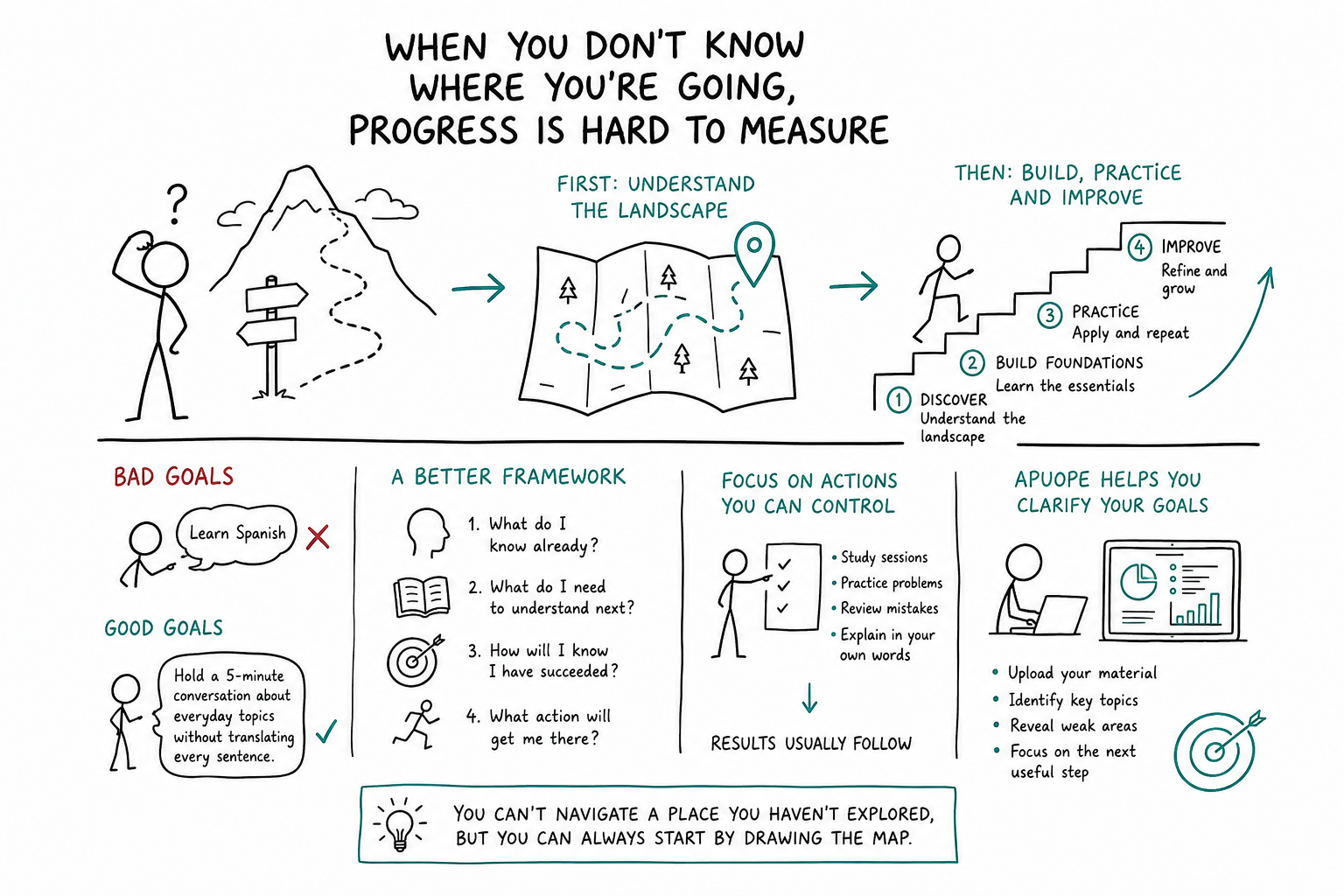
This turns an unknown mountain into a visible map.
Learning happens in levels
Instead of trying to learn everything at once, think of learning as moving through four stages.
Stage 1: Discover
Goal:
Understand the landscape.
Example:
Instead of saying:
“Learn physics.”
Set this goal:
“Identify the ten biggest topics in physics and understand what each one studies.”
Success is not solving equations.
Success is knowing what the subject contains.
Stage 2: Build foundations
Now that you know the map, focus on the essentials.
Ask:
- Which concepts appear everywhere?
- What vocabulary keeps repeating?
- What prerequisite knowledge do I need?
Example:
Instead of:
“Become good at programming.”
Try:
“Understand variables, loops, functions and conditions.”
These become your building blocks.
Stage 3: Practice
Knowledge only becomes useful through repetition.
At this stage, goals should focus on doing.
Examples:
- Solve 20 practice problems.
- Build one small project.
- Explain the topic without notes.
- Teach someone else.
Learning is not measured by reading.
It is measured by what you can actually do.
Stage 4: Improve
Only after you have built a foundation should you chase advanced goals.
Now you can ask:
- Which areas are still weak?
- What mistakes do I repeat?
- Which skills create the biggest improvement?
Your goals become increasingly specific because you finally understand the subject.
A better goal framework
Whenever you are learning something new, ask yourself four questions:
- What do I know already?
- What do I need to understand next?
- How will I know I have succeeded?
- What action will get me there?
If you cannot answer these questions, your goal is probably too vague.
Bad goals versus good goals
Too vague:
Learn biology.
Measurable:
Identify the major branches of biology and explain what each one studies.
Too vague:
Learn mathematics.
Measurable:
Understand the concepts needed to solve linear equations.
Too vague:
Become fluent in English.
Measurable:
Hold a five-minute conversation about everyday topics without translating every sentence.
Notice how every good goal can actually be measured.
Do not confuse goals with outcomes
Many learners say:
“I want an A in the exam.”
That is an outcome.
A learning goal is something you control.
For example:
- Complete three study sessions this week.
- Solve 50 practice questions.
- Review mistakes after every exercise.
- Explain today’s lesson in your own words.
Focus on actions you can control.
The results usually follow.
Your goals will change
Beginners often worry about setting the perfect goal.
You do not need one.
The more you learn, the more your goals evolve.
That is a sign of progress, not failure.
The best learners constantly refine their goals because they understand the subject better than they did yesterday.
How APUOPE helps clarify learning goals
APUOPE helps turn unclear learning intentions into a more visible practice path.
You can upload your learning material, identify the topics that matter and reveal the areas where your understanding is still weak.
Instead of trying to master an entire subject at once, you can focus on the next useful step.
The goal is not vague progress.
The goal is measurable improvement.
Final thoughts
You do not need to know a subject before setting meaningful learning goals.
Your first goal is simply to understand the landscape.
Once you have a map, meaningful goals become much easier to create.
You cannot navigate a place you have not explored, but you can always start by drawing the map.
The clearer your goals become, the easier it is for your brain to decide what deserves attention, what to practice next and how to measure progress.
Learning starts with curiosity.
Progress starts with clear goals.