
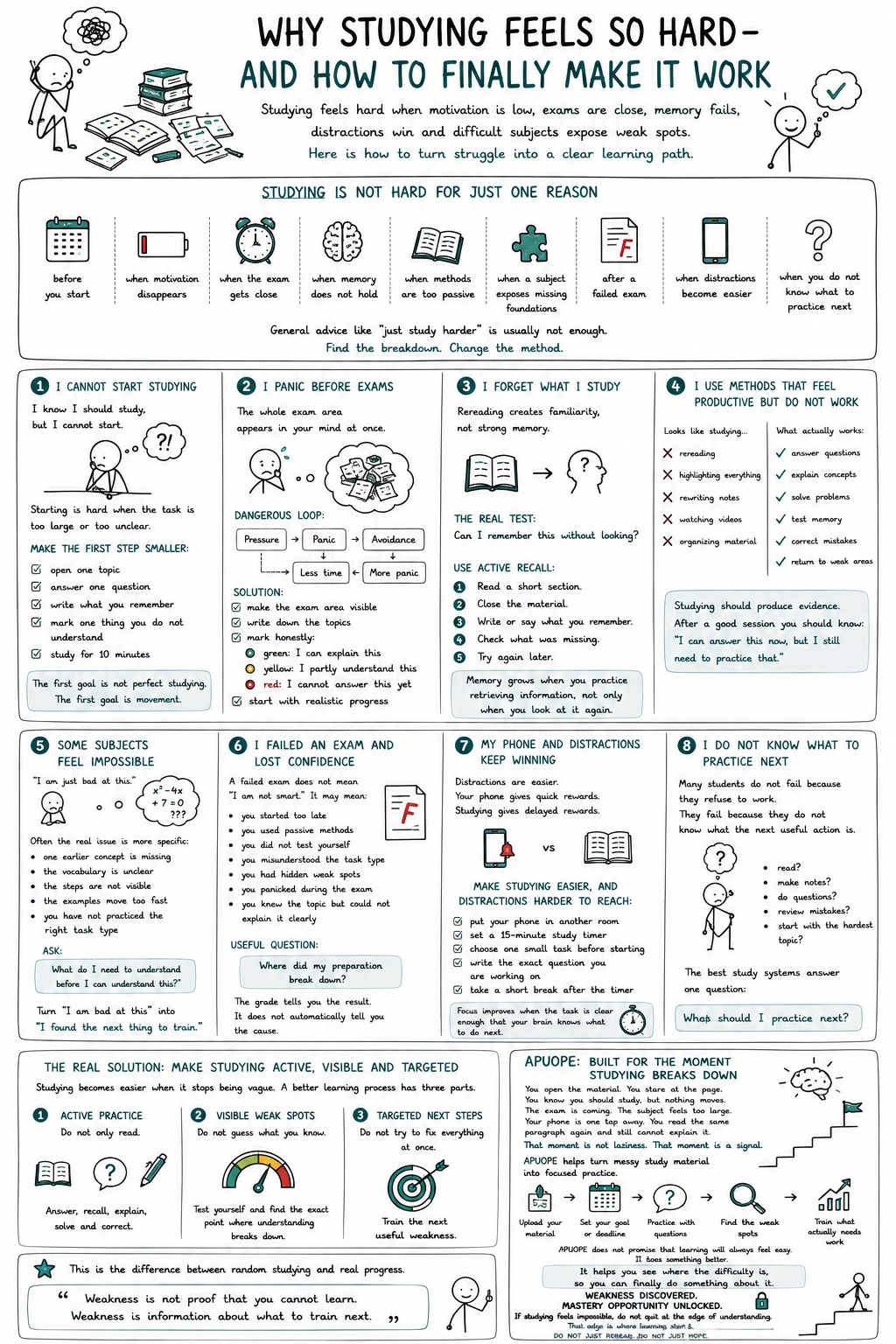
Why does studying feel so hard?
For many students, the answer is not simple.
Studying can feel hard before you even begin. It can feel hard when an exam is getting closer. It can feel hard when you forget what you just studied, when your phone keeps winning, when a subject feels impossible, or when a bad grade destroys your confidence.
That does not mean you are lazy.
It means studying is breaking down somewhere.
The key is to find where the breakdown happens and change the method.
Studying is not hard for just one reason
Most students do not struggle because of one single problem.
Studying can fail in many places:
- before you start
- when motivation disappears
- when the exam gets close
- when memory does not hold
- when study methods are too passive
- when a subject exposes missing foundations
- after a failed exam
- when distractions become easier than the task
- when you do not know what to practice next
This is why general advice like “just study harder” is usually not enough.
If the problem is unclear, effort alone may only create more frustration.
Problem 1: I cannot start studying
One of the most common study problems is simple:
I know I should study, but I cannot start.
This often gets called laziness, but that explanation is too shallow.
Starting becomes difficult when the task is too large or too unclear. “Study biology” is not a clear action. “Prepare for the exam” is not a clear action. Those are giant clouds of pressure.
A better first step is smaller:
- open one topic
- answer one question
- write what you remember
- mark one thing you do not understand
- study for 10 minutes
The first goal is not perfect studying.
The first goal is movement.
Problem 2: I panic before exams
Exam panic often starts when the whole exam area appears in your mind at once.
Suddenly every chapter, note, task and weak topic feels urgent.
This creates a dangerous loop:
Pressure → panic → avoidance → less time → more panic
The solution is not to pretend the exam does not matter.
The solution is to make the exam area visible and manageable.
Write down the topics. Mark them honestly:
- green: I can explain this
- yellow: I partly understand this
- red: I cannot answer this yet
Then start with the topics where progress is still realistic.
Panic becomes smaller when the next action becomes clearer.
Problem 3: I forget what I study
Many students read, highlight and review material, but later feel like everything disappeared.
This happens because rereading often creates familiarity, not strong memory.
The material looks familiar when you see it again, but that does not mean you can recall it without help.
The real test is:
Can I remember this without looking?
To remember more, use active recall:
- Read a short section.
- Close the material.
- Write or say what you remember.
- Check what was missing.
- Try again later.
Memory grows when you practice retrieving information, not only when you look at it again.
Problem 4: I use study methods that feel productive but do not work
Some study methods feel good because they look like studying.
Examples include:
- rereading the same chapter
- highlighting large parts of text
- rewriting notes beautifully
- watching videos without testing yourself
- organizing material instead of using it
These methods are not always useless.
But if they are the only methods you use, they can hide weak understanding.
A stronger study session includes action:
- answering questions
- explaining concepts
- solving problems
- testing memory
- correcting mistakes
- returning to weak areas
Studying should produce evidence.
After a good session, you should know something like:
I can answer this now, but I still need to practice that.
Problem 5: Some subjects feel impossible
Sometimes one subject feels much harder than the others.
Math, science, languages, history or any other subject can become emotionally heavy when the basics are missing.
When a subject feels impossible, students often think:
I am just bad at this.
But often the real issue is more specific:
- one earlier concept is missing
- the vocabulary is unclear
- the steps are not visible
- the examples move too fast
- the student has not practiced the right task type
A difficult subject should be broken down.
Ask:
What do I need to understand before I can understand this?
That question turns “I am bad at this” into “I found the next thing to train.”
Problem 6: I failed an exam and lost confidence
Failing an exam feels bad.
But the worst thing is not the failed exam itself.
The worst thing is turning one result into an identity.
A failed exam does not simply mean “I am not smart.”
It may mean:
- you started too late
- you used passive methods
- you did not test yourself
- you misunderstood the task type
- you had hidden weak spots
- you panicked during the exam
- you knew the topic but could not explain it clearly
The grade tells you the result.
It does not automatically tell you the cause.
The useful question is:
Where did my preparation break down?
When you find the cause, you can change the method.
Problem 7: My phone and distractions keep winning
Studying often loses because distractions are easier.
Your phone gives quick rewards. Studying gives delayed rewards. That is not a fair fight.
When the study task is unclear, the phone becomes even more tempting.
The solution is not only “use more discipline.”
You need to make studying easier to start and distractions harder to reach.
Try this:
- put your phone in another room
- set a 15-minute study timer
- choose one small task before starting
- write the exact question you are working on
- take a short break after the timer
Focus improves when the task is clear enough that your brain knows what to do next.
Problem 8: I do not know what to practice next
This may be the biggest hidden problem in studying.
Many students do not fail because they refuse to work.
They fail because they do not know what the next useful action is.
Should they read?
Should they make notes?
Should they do questions?
Should they review old mistakes?
Should they start with the hardest topic?
When the next step is unclear, studying becomes emotionally heavy.
The best study systems answer one question:
What should I practice next?
The real solution: make studying active, visible and targeted
Studying becomes easier when it stops being vague.
A better learning process has three parts.
1. Active practice
Do not only read. Answer, recall, explain, solve and correct.
2. Visible weak spots
Do not guess what you know. Test yourself and find the exact point where understanding breaks down.
3. Targeted next steps
Do not try to fix everything at once. Train the next useful weakness.
This is the difference between random studying and real progress.
Weakness is not proof that you cannot learn.
Weakness is information about what to train next.
APUOPE: built for the moment studying breaks down
There is a moment every student knows.
You open the material.
You stare at the page.
You know you should study, but nothing moves.
The exam is coming. The subject feels too large. Your phone is one tap away. You read the same paragraph again and still cannot explain it.
That moment is not laziness.
That moment is a signal.
It means your brain needs a clearer task, better feedback and a way to find the exact weak point.
That is why APUOPE exists.
APUOPE helps turn messy study material into focused practice. It helps students move from passive reading to active learning, from panic to structure, from hidden weakness to visible progress.
- Upload your learning material.
- Set your goal or exam deadline.
- Practice with questions.
- Find the weak spots.
- Train what actually needs work.
APUOPE does not promise that learning will always feel easy.
It does something better.
It helps you see where the difficulty is, so you can finally do something about it.
Weakness discovered.
Mastery opportunity unlocked.
If studying feels impossible, do not quit at the edge of understanding.
That edge is where learning starts.
Do not just reread. Do not just hope. Do not wait until panic starts.
Upload the struggle. Download mastery.