
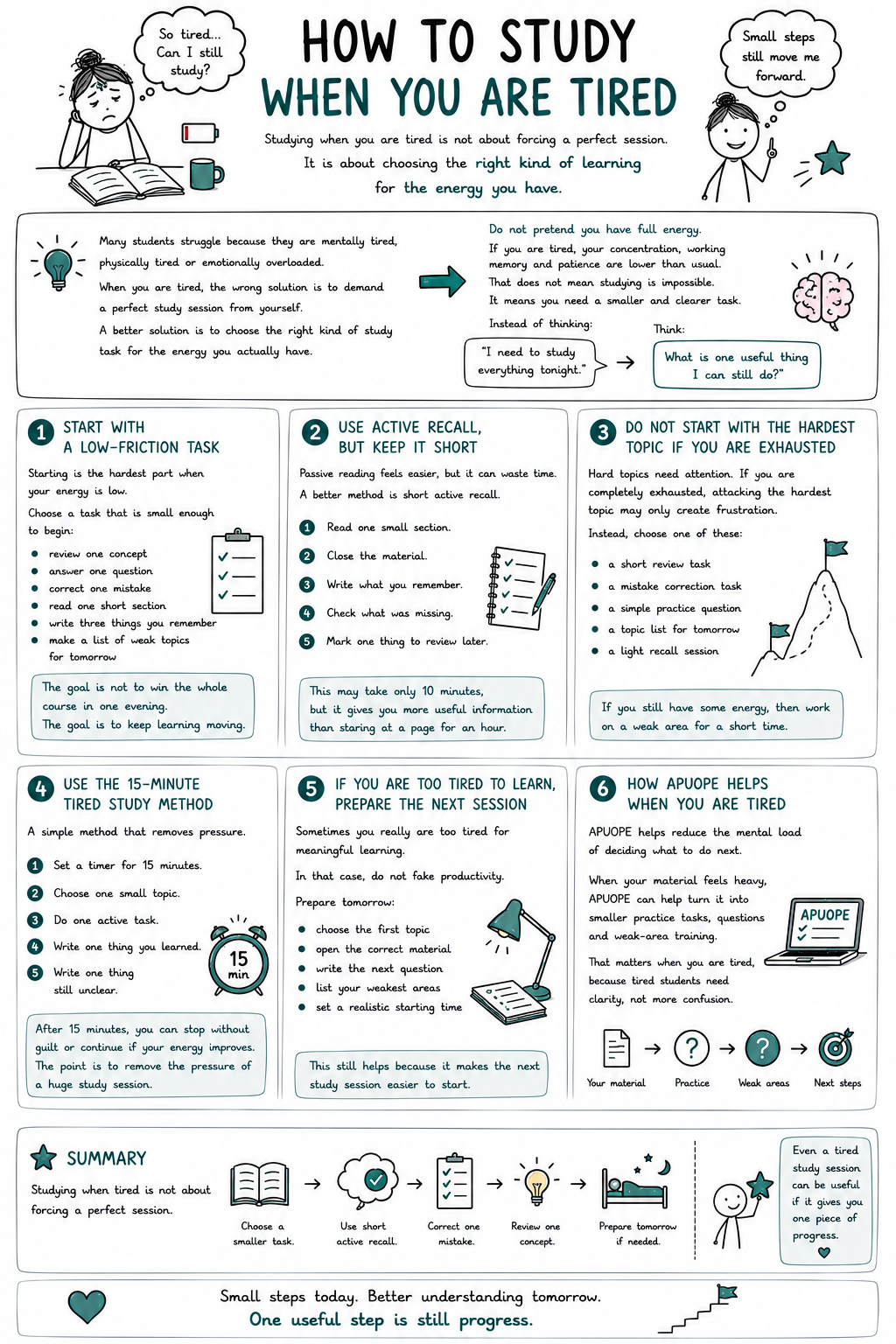
How do you study when you are tired?
This is a real problem. Many students do not struggle because they do not care. They struggle because they are mentally tired, physically tired or emotionally overloaded.
When you are tired, the wrong solution is to demand a perfect study session from yourself.
A better solution is to choose the right kind of study task for the energy you actually have.
Do not pretend you have full energy
If you are tired, your concentration, working memory and patience are lower than usual.
That does not mean studying is impossible.
It means you need a smaller and clearer task.
Instead of thinking:
I need to study everything tonight.
Think:
What is one useful thing I can still do?
Start with a low-friction task
When your energy is low, starting is the hardest part.
Choose a task that is small enough to begin:
- review one concept
- answer one question
- correct one mistake
- read one short section
- write three things you remember
- make a list of weak topics for tomorrow
The goal is not to win the whole course in one evening.
The goal is to keep learning moving.
Use active recall, but keep it short
When tired, many students fall into passive reading. It feels easier, but it can waste time.
A better method is short active recall.
Try this:
- Read one small section.
- Close the material.
- Write what you remember.
- Check what was missing.
- Mark one thing to review later.
This may take only 10 minutes, but it gives you more useful information than staring at a page for an hour.
Do not start with the hardest topic if you are exhausted
Hard topics need attention. If you are completely exhausted, attacking the hardest topic may only create frustration.
Instead, choose one of these:
- a short review task
- a mistake correction task
- a simple practice question
- a topic list for tomorrow
- a light recall session
If you still have some energy, then work on a weak area for a short time.
Use the 15-minute tired study method
Here is a simple method:
- Set a timer for 15 minutes.
- Choose one small topic.
- Do one active task.
- Write one thing you learned.
- Write one thing still unclear.
After 15 minutes, you can stop without guilt or continue if your energy improves.
The point is to remove the pressure of a huge study session.
If you are too tired to learn, prepare the next session
Sometimes you really are too tired for meaningful learning.
In that case, do not fake productivity.
Prepare tomorrow:
- choose the first topic
- open the correct material
- write the next question
- list your weakest areas
- set a realistic starting time
This still helps because it makes the next study session easier to start.
How APUOPE helps when you are tired
APUOPE helps reduce the mental load of deciding what to do next.
When your material feels heavy, APUOPE can help turn it into smaller practice tasks, questions and weak-area training.
That matters when you are tired, because tired students need clarity, not more confusion.
Summary
Studying when tired is not about forcing a perfect session.
Choose a smaller task. Use short active recall. Correct one mistake. Review one concept. Prepare tomorrow if needed.
Even a tired study session can be useful if it gives you one piece of progress.