
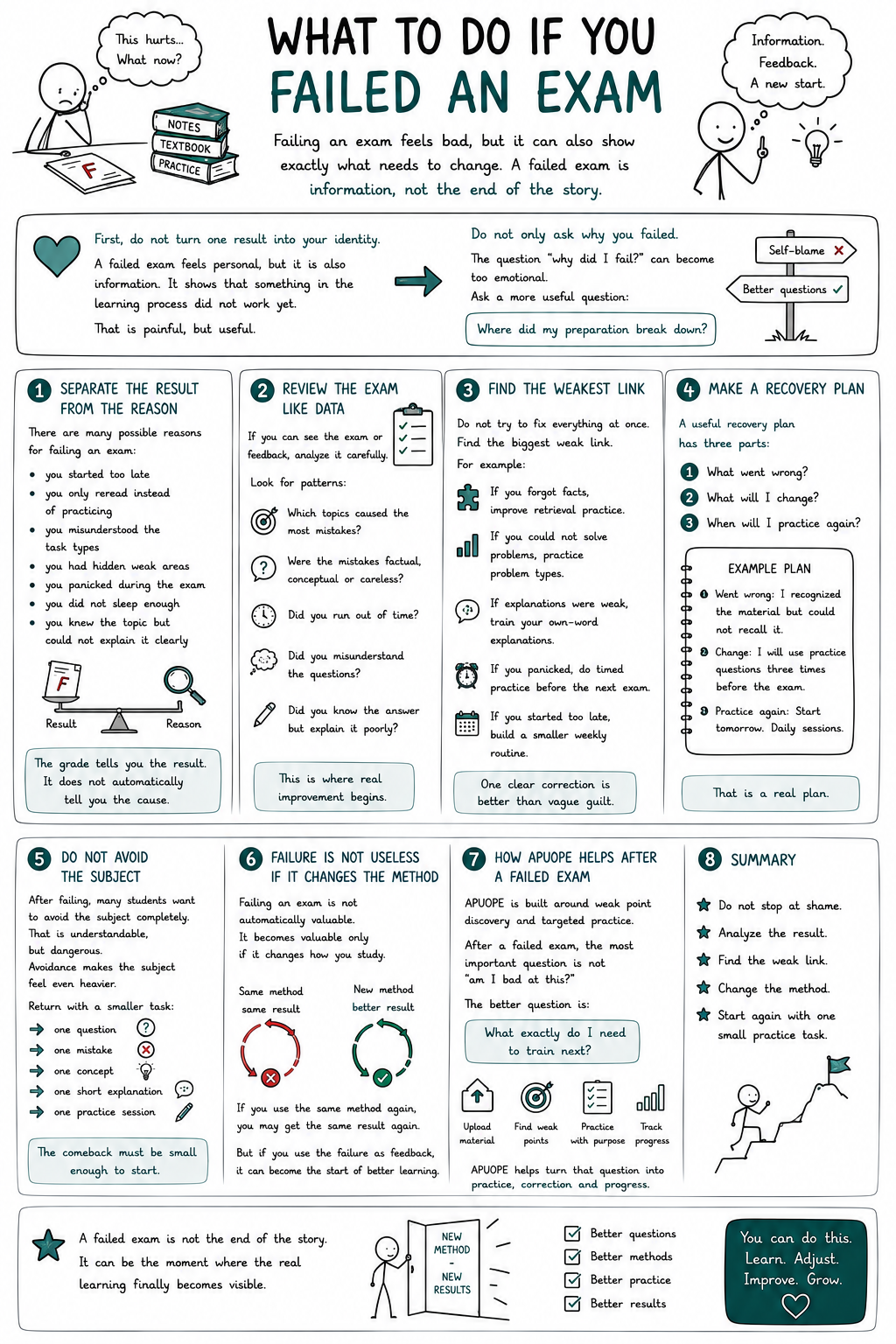
What should you do if you failed an exam?
First, do not turn one result into your identity.
A failed exam feels personal, but it is also information. It shows that something in the learning process did not work yet.
That is painful, but useful.
Do not only ask why you failed
The question “why did I fail?” can become too emotional.
Ask a more useful question:
Where did my preparation break down?
This turns the failure into a problem you can examine.
Separate the result from the reason
There are many possible reasons for failing an exam:
- you started too late
- you only reread instead of practicing
- you misunderstood the task types
- you had hidden weak areas
- you panicked during the exam
- you did not sleep enough
- you knew the topic but could not explain it clearly
The grade tells you the result.
It does not automatically tell you the cause.
Review the exam like data
If you can see the exam or feedback, analyze it carefully.
Look for patterns:
- Which topics caused the most mistakes?
- Were the mistakes factual, conceptual or careless?
- Did you run out of time?
- Did you misunderstand the questions?
- Did you know the answer but explain it poorly?
This is where real improvement begins.
Find the weakest link
Do not try to fix everything at once.
Find the biggest weak link.
For example:
- If you forgot facts, improve retrieval practice.
- If you could not solve problems, practice problem types.
- If explanations were weak, train your own-word explanations.
- If you panicked, do timed practice before the next exam.
- If you started too late, build a smaller weekly routine.
One clear correction is better than vague guilt.
Make a recovery plan
A useful recovery plan has three parts:
- What went wrong?
- What will I change?
- When will I practice again?
For example:
I failed because I recognized the material but could not recall it. Next time I will use practice questions three times before the exam.
That is a real plan.
Do not avoid the subject
After failing, many students want to avoid the subject completely.
That is understandable, but dangerous.
Avoidance makes the subject feel even heavier.
Return with a smaller task:
- one question
- one mistake
- one concept
- one short explanation
- one practice session
The comeback must be small enough to start.
Failure is not useless if it changes the method
Failing an exam is not automatically valuable.
It becomes valuable only if it changes how you study.
If you use the same method again, you may get the same result again.
But if you use the failure as feedback, it can become the start of better learning.
How APUOPE helps after a failed exam
APUOPE is built around weak point discovery and targeted practice.
After a failed exam, the most important question is not “am I bad at this?”
The better question is:
What exactly do I need to train next?
APUOPE helps turn that question into practice, correction and progress.
Summary
If you failed an exam, do not stop at shame.
Analyze the result. Find the weak link. Change the method. Start again with one small practice task.
A failed exam is not the end of the story.
It can be the moment where the real learning finally becomes visible.