
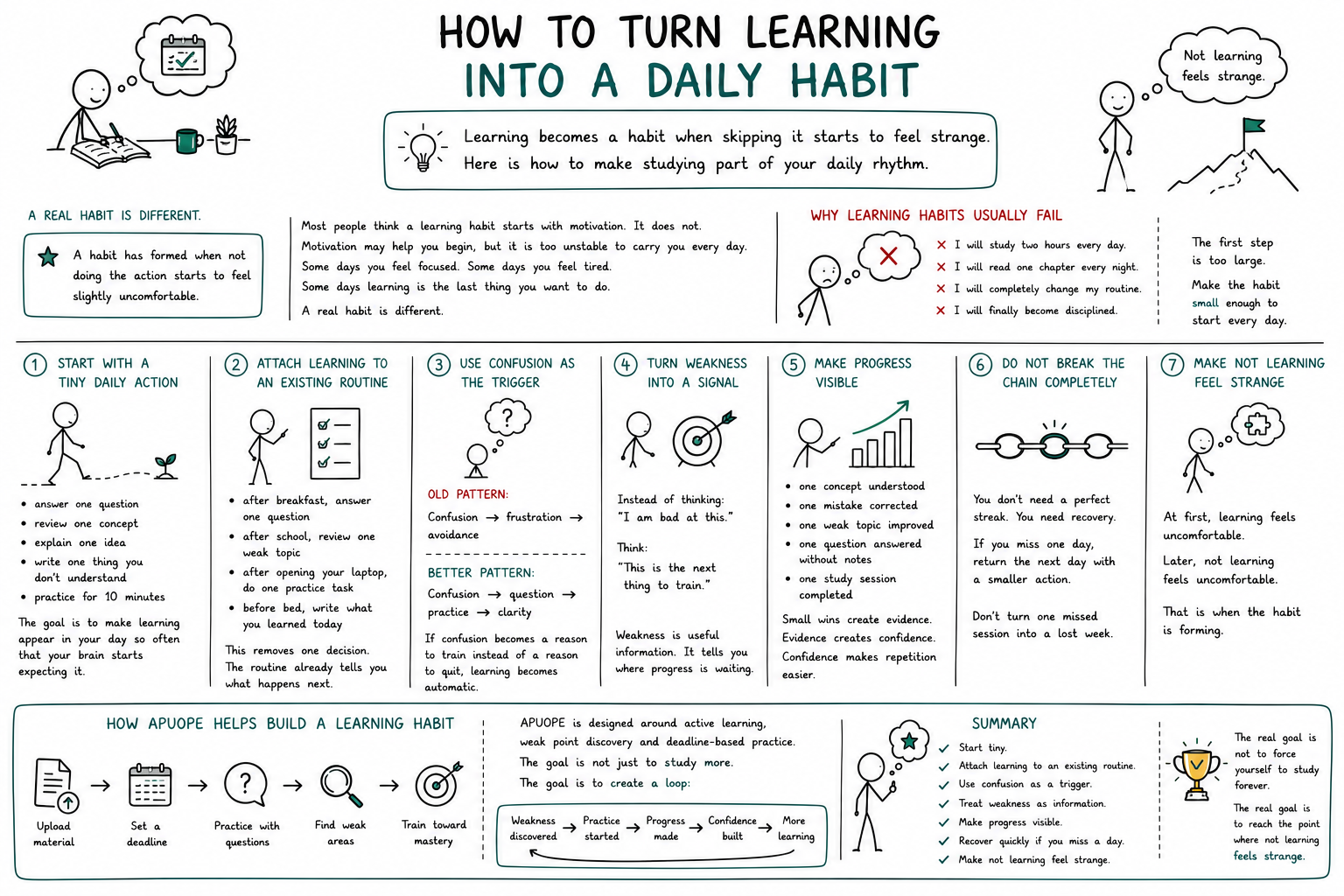
How do you turn learning into a daily habit?
Most people think a learning habit starts with motivation. It does not.
Motivation may help you begin, but it is too unstable to carry you every day. Some days you feel focused. Some days you feel tired. Some days learning is the last thing you want to do.
A real habit is different.
A habit has formed when not doing the action starts to feel slightly uncomfortable.
That is the point where learning stops being something you force yourself to do and starts becoming part of who you are.
Why learning habits usually fail
Many students try to build a learning habit in the wrong way.
They decide:
- I will study two hours every day.
- I will read one chapter every night.
- I will completely change my routine.
- I will finally become disciplined.
The problem is that the first step is too large.
When the brain sees studying as a huge task, it creates resistance. The action feels heavy before it even begins.
That is why the first rule is simple:
Make the habit small enough to start every day.
Step 1: Start with a tiny daily action
Do not begin with a perfect study routine.
Begin with one small action:
- answer one question
- review one concept
- explain one idea in your own words
- write one thing you do not understand
- practice for 10 minutes
The goal is not to become perfect on day one.
The goal is to make learning appear in your day so often that your brain starts expecting it.
Step 2: Attach learning to an existing routine
Habits are easier to build when they connect to something you already do.
For example:
- after breakfast, answer one question
- after school, review one weak topic
- after opening your laptop, do one practice task
- before bed, write what you learned today
This removes one decision.
You no longer ask, “Should I study now?”
The routine already tells you what happens next.
Step 3: Use confusion as the trigger
Many students stop when they feel confused.
But confusion can also become the trigger for learning.
The old pattern looks like this:
Confusion → frustration → avoidance
The better pattern looks like this:
Confusion → question → practice → clarity
This is a powerful shift.
If confusion becomes a reason to train instead of a reason to quit, learning starts to become automatic.
Step 4: Turn weakness into a signal
Weakness feels bad when you see it as proof that you are not good enough.
But weakness is also useful information.
It tells you exactly where progress is waiting.
Instead of thinking:
I am bad at this.
Think:
This is the next thing to train.
That emotional change matters. A daily learning habit becomes easier when weak areas feel like targets, not threats.
Step 5: Make progress visible
People repeat actions when they feel progress.
If learning feels invisible, it becomes hard to continue.
Track small wins:
- one concept understood
- one mistake corrected
- one weak topic improved
- one question answered without notes
- one study session completed
Small wins create evidence.
Evidence creates confidence.
Confidence makes repetition easier.
Step 6: Do not break the chain completely
You do not need a perfect streak.
You need recovery.
If you miss one day, return the next day with a smaller action.
Do not turn one missed session into a lost week.
The habit is not destroyed by missing once. It is destroyed by making the return too difficult.
Step 7: Make not learning feel strange
This is the turning point.
At first, learning feels uncomfortable.
Later, not learning feels uncomfortable.
That is when the habit is forming.
You begin to feel that something is missing if you have not trained your mind, answered a question or moved one step closer to mastery.
How APUOPE helps build a learning habit
APUOPE is designed around active learning, weak point discovery and deadline-based practice.
Instead of only reading material, you can turn learning into repeated action:
- upload material
- set a deadline
- practice with questions
- find weak areas
- train toward mastery
The goal is not just to study more.
The goal is to create a loop:
Weakness discovered → practice started → progress made → confidence built → more learning
Summary
Learning becomes a daily habit when the action is small, repeatable and emotionally rewarding.
Start tiny. Attach learning to an existing routine. Use confusion as a trigger. Treat weakness as information. Make progress visible.
The real goal is not to force yourself to study forever.
The real goal is to reach the point where not learning feels strange.