
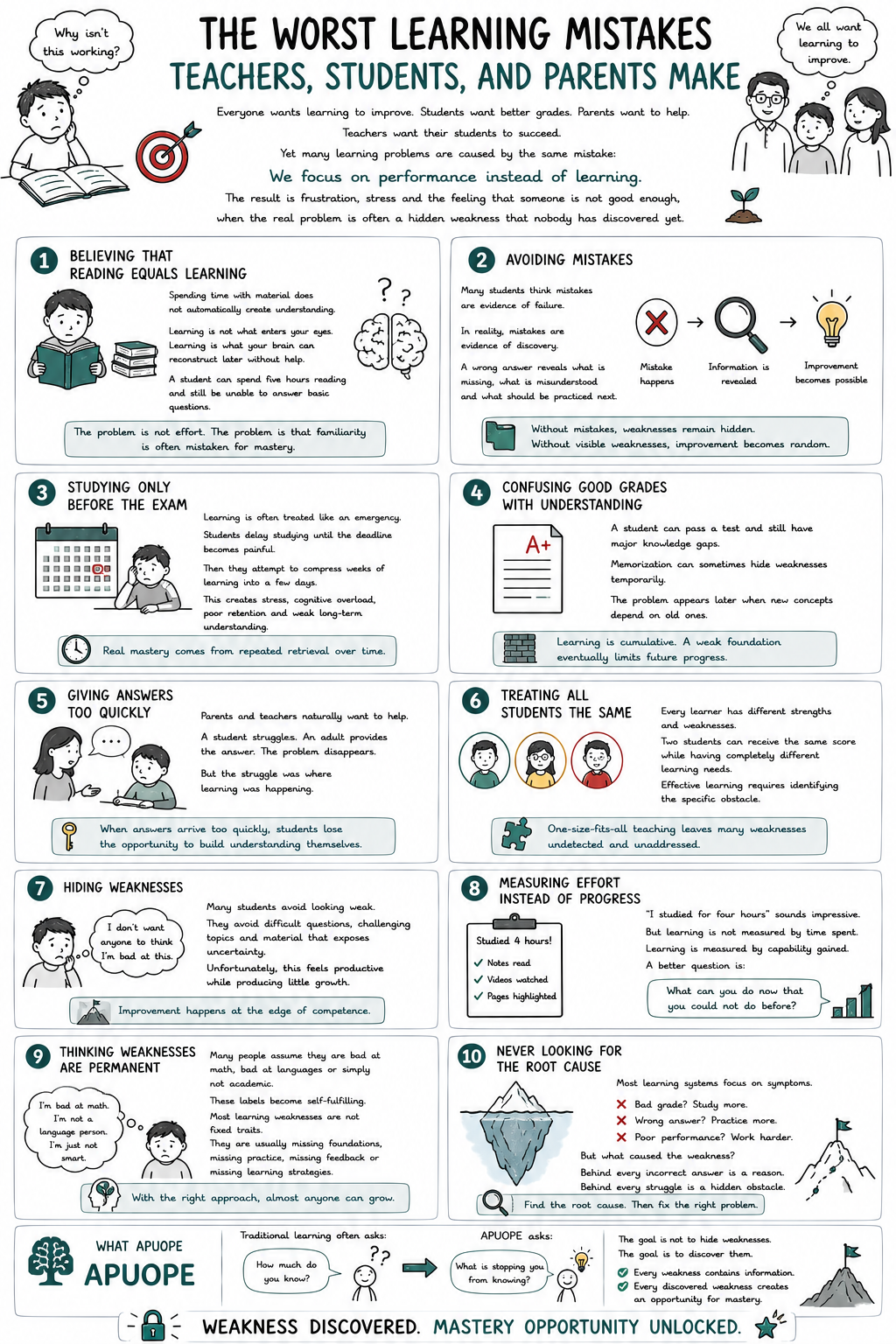
Everyone wants learning to improve.
Students want better grades. Parents want to help. Teachers want their students to succeed.
Yet many learning problems are caused by the same mistake:
We focus on performance instead of learning.
The result is frustration, stress and the feeling that someone is not good enough, when the real problem is often a hidden weakness that nobody has discovered yet.
Mistake #1: Believing That Reading Equals Learning
One of the biggest learning myths is that spending time with material automatically creates understanding.
Learning is not what enters your eyes. Learning is what your brain can reconstruct later without help.
A student can spend five hours reading and still be unable to answer basic questions.
The problem is not effort. The problem is that familiarity is often mistaken for mastery.
Mistake #2: Avoiding Mistakes
Many students think mistakes are evidence of failure.
In reality, mistakes are evidence of discovery.
A wrong answer reveals what is missing, what is misunderstood and what should be practiced next.
Without mistakes, weaknesses remain hidden. Without visible weaknesses, improvement becomes random.
Mistake #3: Studying Only Before the Exam
Learning is often treated like an emergency.
Students delay studying until the deadline becomes painful. Then they attempt to compress weeks of learning into a few days.
This creates stress, cognitive overload, poor retention and weak long-term understanding.
Real mastery comes from repeated retrieval over time.
Mistake #4: Confusing Good Grades with Understanding
A student can pass a test and still have major knowledge gaps.
Memorization can sometimes hide weaknesses temporarily. The problem appears later when new concepts depend on old ones.
Learning is cumulative. A weak foundation eventually limits future progress.
Mistake #5: Giving Answers Too Quickly
Parents and teachers naturally want to help.
A student struggles. An adult provides the answer. The problem disappears.
But the struggle was where learning was happening.
When answers arrive too quickly, students lose the opportunity to build understanding themselves.
Mistake #6: Treating All Students the Same
Every learner has different strengths and weaknesses.
Two students can receive the same score while having completely different learning needs.
One may struggle with memory. Another may struggle with conceptual understanding. A third may have gaps in prerequisite knowledge.
Effective learning requires identifying the specific obstacle.
Mistake #7: Hiding Weaknesses
Many students spend enormous energy trying to avoid looking weak.
They avoid difficult questions, challenging topics and material that exposes uncertainty.
Unfortunately, this feels productive while producing little growth.
Improvement happens at the edge of competence.
Mistake #8: Measuring Effort Instead of Progress
“I studied for four hours” sounds impressive.
But learning is not measured by time spent. Learning is measured by capability gained.
A better question is:
What can you do now that you could not do before?
Mistake #9: Thinking Weaknesses Are Permanent
Many people assume they are bad at math, bad at languages or simply not academic.
These labels become self-fulfilling.
Most learning weaknesses are not fixed traits. They are usually missing foundations, missing practice, missing feedback or missing learning strategies.
Mistake #10: Never Looking for the Root Cause
Most learning systems focus on symptoms.
Bad grade? Study more.
Wrong answer? Practice more.
Poor performance? Work harder.
But what caused the weakness?
Behind every incorrect answer is a reason. Behind every struggle is a hidden obstacle.
What APUOPE Believes
Traditional learning often asks:
How much do you know?
APUOPE asks:
What is stopping you from knowing?
The goal is not to hide weaknesses. The goal is to discover them.
Because every weakness contains information. And every discovered weakness creates an opportunity for mastery.
Weakness discovered.
Mastery opportunity unlocked.