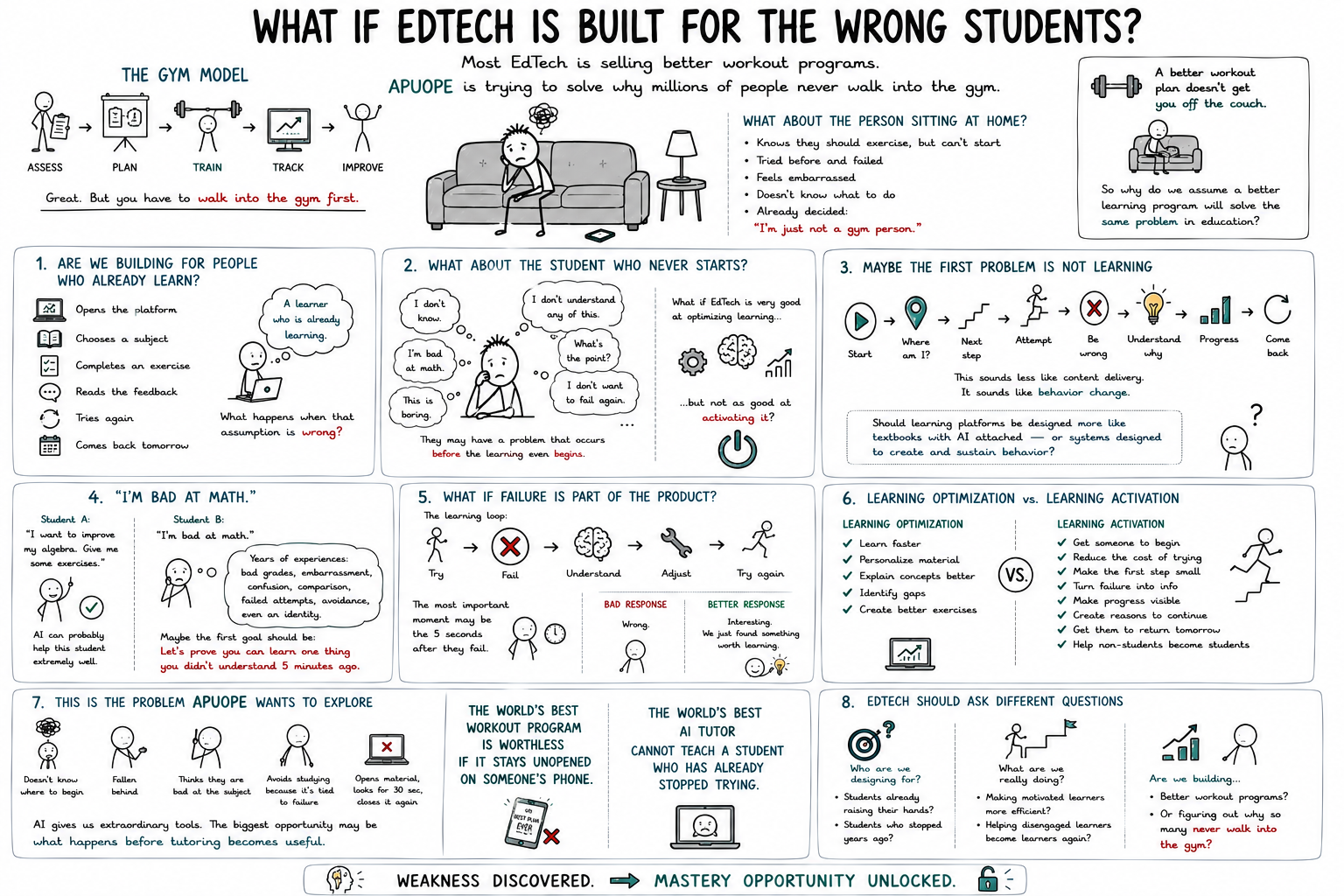
Most EdTech is selling better workout programs. APUOPE is trying to solve why millions of people never walk into the gym.
Imagine the fitness industry.
You walk into a gym.
A personal trainer asks about your goals, analyzes your current fitness level, creates a personalized workout plan, tracks your progress and adjusts the program as you improve.
Great.
But there is one problem.
You have to walk into the gym first.
What about the person sitting at home?
The person who knows they should exercise but cannot get started.
The person who has tried before and failed.
The person who feels embarrassed about being out of shape.
The person who does not know what to do once they get there.
The person who has already decided:
"I'm just not a gym person."
Would giving that person a better workout program solve the problem?
Probably not.
So why do we assume that a better learning program will solve the same problem in education?
Are We Building Learning Tools for People Who Already Learn?
A lot of modern EdTech is becoming incredibly sophisticated.
AI tutors can explain difficult concepts.
Learning platforms can personalize exercises.
Algorithms can identify weaknesses.
Systems can generate quizzes, flashcards, summaries and study plans almost instantly.
These are useful capabilities.
But look carefully at the person they often assume exists on the other side of the screen.
A learner who opens the platform.
A learner who chooses a subject.
A learner who completes an exercise.
A learner who reads the feedback.
A learner who tries again.
A learner who comes back tomorrow.
In other words:
A learner who is already learning.
What happens when that assumption is wrong?
What About the Student Who Never Starts?
Ask a struggling student:
"What do you want to learn today?"
You might expect a subject.
Math.
English.
Physics.
History.
But the real answer may be something completely different.
"I don't know."
"I don't understand any of this."
"I'm bad at math."
"I have a test tomorrow and I haven't started."
"This is boring."
"What's the point?"
"I don't want to fail again."
Or perhaps they do not answer at all.
They simply close the laptop.
That student does not necessarily need a more sophisticated explanation of quadratic equations.
They may have a problem that occurs before the learning even begins.
And this raises an uncomfortable question:
What if EdTech has become very good at optimizing learning while paying much less attention to activating it?
A Better Workout Plan Does Not Get You Off the Couch
Fitness gives us a useful analogy.
If someone already trains four times a week, better data can help.
A better program can help.
A personal trainer can help.
Nutrition tracking can help.
Recovery analysis can help.
But imagine someone who has not exercised for three years.
Giving them the world's most scientifically optimized six-day training program might actually make things worse.
It creates distance between where they are and where the system expects them to be.
Education can do the same thing.
We give students:
more content,
better explanations,
more exercises,
AI tutors,
dashboards,
recommendations,
study plans,
and increasingly sophisticated personalization.
But what if the student's real problem is:
"I cannot make myself start."
What does our personalization algorithm personalize then?
Maybe the First Problem Is Not Learning
Before meaningful learning can happen, several other things may need to happen.
The learner needs to start.
They need to understand where they are.
They need to see a reachable next step.
They need to attempt something.
They need to survive being wrong.
They need to understand why they were wrong.
They need to experience some form of progress.
And eventually, they need to come back.
That sounds less like content delivery.
It sounds like behavior change.
Which creates another question:
Should learning platforms be designed more like textbooks with AI attached to them — or like systems designed to create and sustain behavior?
The Student Who Says "I'm Bad at Math"
Consider two students.
The first says:
"I want to improve my algebra. Give me some exercises."
Fantastic.
AI can probably help that student extremely well.
Now consider another student.
"I'm bad at math."
That sentence is completely different.
It is not a request for content.
It may contain years of experiences.
Bad grades.
Embarrassment.
Comparison with classmates.
Failed attempts.
Confusion.
Avoidance.
Maybe even an identity:
Math is something other people can do.
What should an intelligent learning system do with that?
Generate ten algebra exercises?
Explain algebra more clearly?
Or should it first try to create one small experience that contradicts the learner's existing belief?
Maybe the first goal should not be:
Learn algebra.
Maybe it should be:
Let's prove that you can learn one thing you didn't understand five minutes ago.
That is a very different design philosophy.
What If Failure Is Part of the Product?
There is another problem.
Learning requires being wrong.
You attempt something.
Your mental model fails.
You receive information.
You adjust.
You try again.
But many students have learned to interpret exactly that process as evidence that they are bad at learning.
Wrong answer.
Red.
Failure.
Next question.
Wrong again.
Red.
Failure.
Eventually:
"I can't do this."
So what should a learning platform optimize?
The number of correct answers?
Or the learner's ability to continue after an incorrect one?
Those are not necessarily the same thing.
Perhaps one of the most important moments in a learning product is not when the learner succeeds.
Perhaps it is the five seconds after they fail.
What happens then?
Does the system make them feel evaluated?
Or does it make them curious?
Does it say:
Wrong.
Or does it communicate:
Interesting. We just found something worth learning.
Learning Optimization vs. Learning Activation
This may be one of the most important distinctions in EdTech.
There is learning optimization:
How can we help someone learn faster?
How can we personalize the material?
How can we explain concepts better?
How can we identify knowledge gaps?
How can we create better exercises?
All valuable questions.
But there is another category:
Learning activation.
How do we get someone to begin?
How do we reduce the psychological cost of trying?
How do we make the first step small enough?
How do we turn failure into information?
How do we make progress visible?
How do we create reasons to continue?
How do we get the learner to return tomorrow?
And eventually:
How do we help someone who doesn't study become someone who does?
This Is the Problem APUOPE Wants to Explore
APUOPE is not based on the assumption that every learner arrives motivated, organized and ready to study.
Quite the opposite.
We are interested in the messy part.
The student who does not know where to begin.
The student who has fallen behind.
The student who thinks they are bad at the subject.
The student who avoids studying because studying has become associated with failure.
The student who opens the material, looks at it for thirty seconds and closes it again.
AI gives us extraordinary new tools for education.
But perhaps the most interesting opportunity is not simply building a better AI tutor.
Maybe it is building systems that understand what happens before tutoring becomes useful.
Because the world's best workout program is worthless if it stays unopened on someone's phone.
And the world's best AI tutor cannot teach a student who has already stopped trying.
So perhaps EdTech should ask itself a different set of questions:
Who are we actually designing for?
The students already raising their hands?
Or the students who stopped raising them years ago?
Are we making motivated learners more efficient?
Or are we helping disengaged learners become learners again?
Are we building better workout programs?
Or are we finally going to figure out why so many people never walk into the gym?