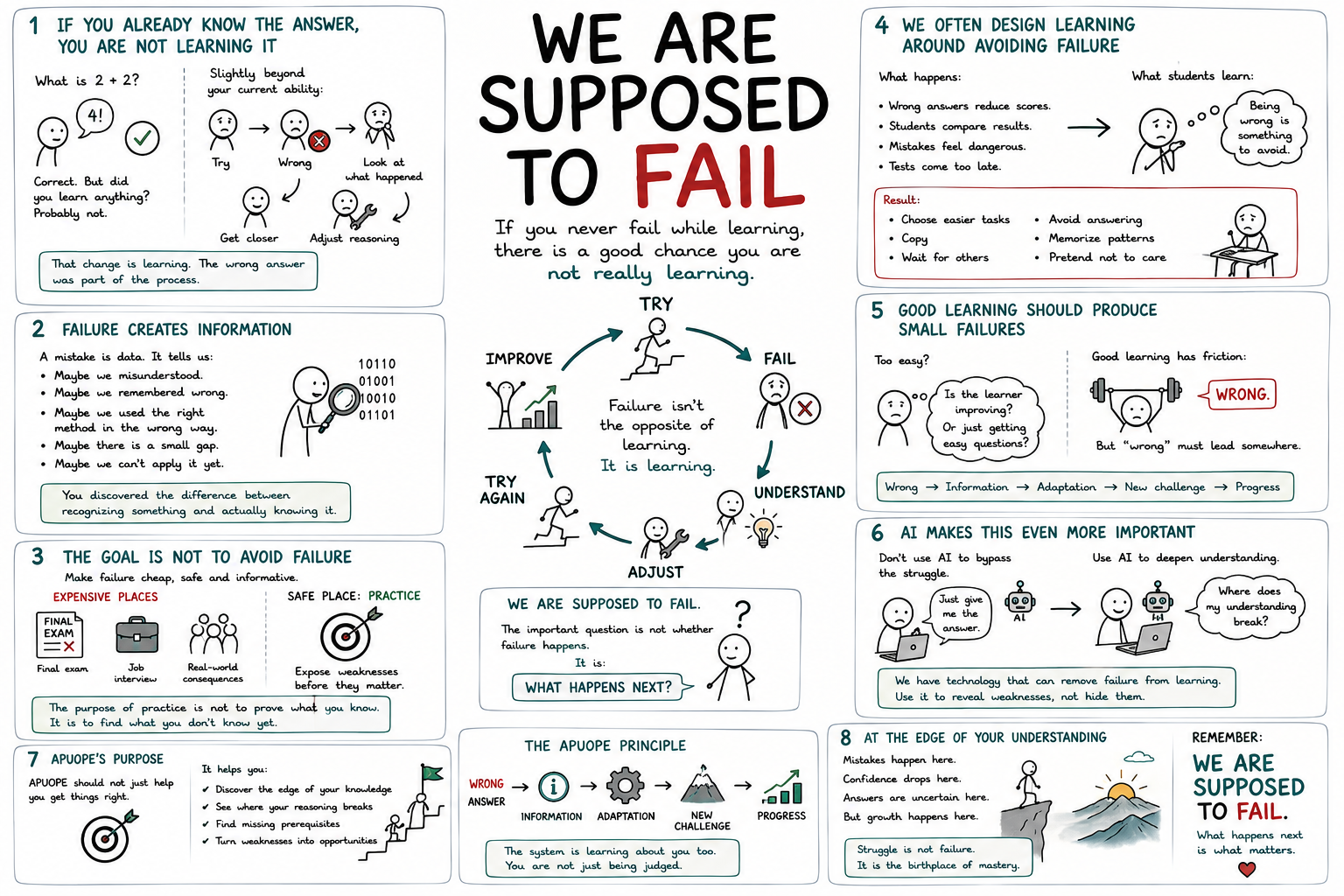
If you never fail while learning, there is a good chance you are not really learning.
Failure has a terrible reputation in education.
A wrong answer means you did not know.
A low score means you did not learn enough.
A mistake means something went wrong.
And success?
Success means getting it right.
But there is a problem with this way of thinking:
Learning requires failure.
Not catastrophic failure. Not humiliation. Not repeatedly failing without understanding why.
But small, useful failures.
The kind that tell your brain:
What you thought would work did not work. Something needs to change.
That is not the opposite of learning.
That is learning.
If You Already Know the Answer, You Are Not Learning It
Imagine I ask you:
What is 2 + 2?
You answer:
4.
Correct.
But did you learn anything?
Probably not.
You simply retrieved something you already knew.
Now imagine I give you a problem that is slightly beyond your current ability.
You try.
You get it wrong.
You look at what happened.
You adjust your reasoning.
You try again.
And this time, you get closer.
Something has changed.
Your understanding is now different from what it was before.
That change is learning.
And the wrong answer was part of the process that produced it.
Failure Creates Information
A mistake is not just a bad result.
It is data.
It tells us something about the current state of our understanding.
Maybe we misunderstood the concept.
Maybe we remembered something incorrectly.
Maybe we used the right method in the wrong situation.
Maybe there is a small gap in our knowledge that causes everything after it to collapse.
Or maybe we understand the subject perfectly well but cannot yet apply that understanding in a new context.
Without failure, many of these weaknesses remain invisible.
You can read a chapter and feel like you understand it.
You can watch someone solve a problem and think:
"Yes, that makes sense."
You can highlight notes, reread definitions and recognize every term on the page.
Everything feels familiar.
Then someone asks you to explain it without looking.
And suddenly:
Nothing.
That moment can feel like failure.
But something extremely valuable just happened.
You discovered the difference between recognizing something and actually knowing it.
That information is useful.
The Goal Should Not Be to Avoid Failure
The goal should be to make failure cheap, safe and informative.
That distinction matters.
There are environments where failure is expensive.
A final exam is one.
A job interview is another.
A real-world situation where your decisions affect other people can be another.
Those are terrible places to discover fundamental weaknesses for the first time.
Practice should be different.
Practice should be the place where we deliberately expose weaknesses before they matter.
You try.
You fail.
You understand why.
You adjust.
You try again.
And eventually something that once required effort becomes something you can do.
The purpose of practice is not to prove that you already know.
The purpose of practice is to find what you don't know yet.
Yet We Often Design Learning Around Avoiding Failure
This is where education can become strangely contradictory.
We tell students that mistakes are part of learning.
Then we create environments where mistakes feel dangerous.
Wrong answers reduce scores.
Students compare results.
Someone answers incorrectly in front of the class.
Tests reveal weaknesses when there may no longer be much time to fix them.
Eventually students learn another lesson:
Being wrong is something to avoid.
And once avoiding failure becomes the goal, behavior changes.
Students choose easier tasks.
They avoid answering when uncertain.
They copy.
They memorize patterns instead of exploring concepts.
They wait for someone else to answer.
They may even pretend not to care.
Because if failure threatens your grade, status or self-image, avoiding failure can become perfectly rational behavior.
The tragedy is that the learner may successfully protect themselves from exactly the experiences that would help them improve.
Good Learning Should Produce Small Failures
A learning system that constantly tells you:
Correct. Correct. Correct. Correct.
may feel great.
But we should ask an uncomfortable question:
Is the learner improving, or is the system simply asking questions they can already answer?
If everything is easy, the learner may be operating entirely inside their existing competence.
There should be friction.
There should be uncertainty.
There should occasionally be:
Wrong.
But that "wrong" needs to lead somewhere.
A useful learning loop looks more like this:
Try → Fail → Understand → Adjust → Try again → Improve
The important part is not failure alone.
Failure without feedback can simply become frustration.
The value comes from what happens after the mistake.
AI Makes This Even More Important
AI is making correct answers incredibly cheap.
If the objective is simply to produce an answer, increasingly we can ask AI to produce one.
That changes what valuable learning looks like.
A student can now avoid enormous amounts of productive struggle.
Don't know the answer?
Ask AI.
Can't solve the equation?
Ask AI.
Can't start the essay?
Ask AI.
Don't understand the concept?
Ask AI to explain it — or, more dangerously, simply ask it to complete the task.
The result can look like success.
The assignment is finished.
The answer is correct.
The output looks impressive.
But the learner may have successfully bypassed the exact moment where learning could have happened.
This creates a strange new challenge for education:
We have technology capable of removing failure from the learning process precisely when failure may be more important than ever.
The answer is not to remove AI.
The answer is to use AI differently.
Instead of:
"Give me the answer."
AI can help us ask:
"Where does my understanding break?"
That is a much more interesting use of intelligence.
APUOPE Should Not Just Help You Get Things Right
This is an important principle behind APUOPE.
The goal should not be to create a system that constantly makes the learner feel successful.
It should help the learner discover the edge of their knowledge.
What do you already understand?
What do you think you understand?
Where does your reasoning begin to break?
Which prerequisite is missing?
What should you practice next?
And once a weakness is discovered:
Can we turn it into the next learning opportunity?
That changes the meaning of a wrong answer.
Instead of:
Wrong answer → failure
we can build:
Wrong answer → information → adaptation → new challenge → progress
The learner is no longer simply being judged.
The system is learning about the learner too.
We Are Supposed to Fail
A learner who fails occasionally is not necessarily doing badly.
They may be exactly where they need to be.
At the boundary between what they can already do and what they are trying to learn.
That boundary is uncomfortable.
Answers are uncertain there.
Mistakes happen there.
Confidence sometimes drops there.
But growth happens there too.
So perhaps we should stop designing learning around the fantasy that good learners constantly succeed.
They don't.
They guess.
They misunderstand.
They forget.
They choose the wrong approach.
They discover gaps.
They adjust.
And then they try again.
We are supposed to fail.
The important question is not whether failure happens.
It is:
What happens next?