
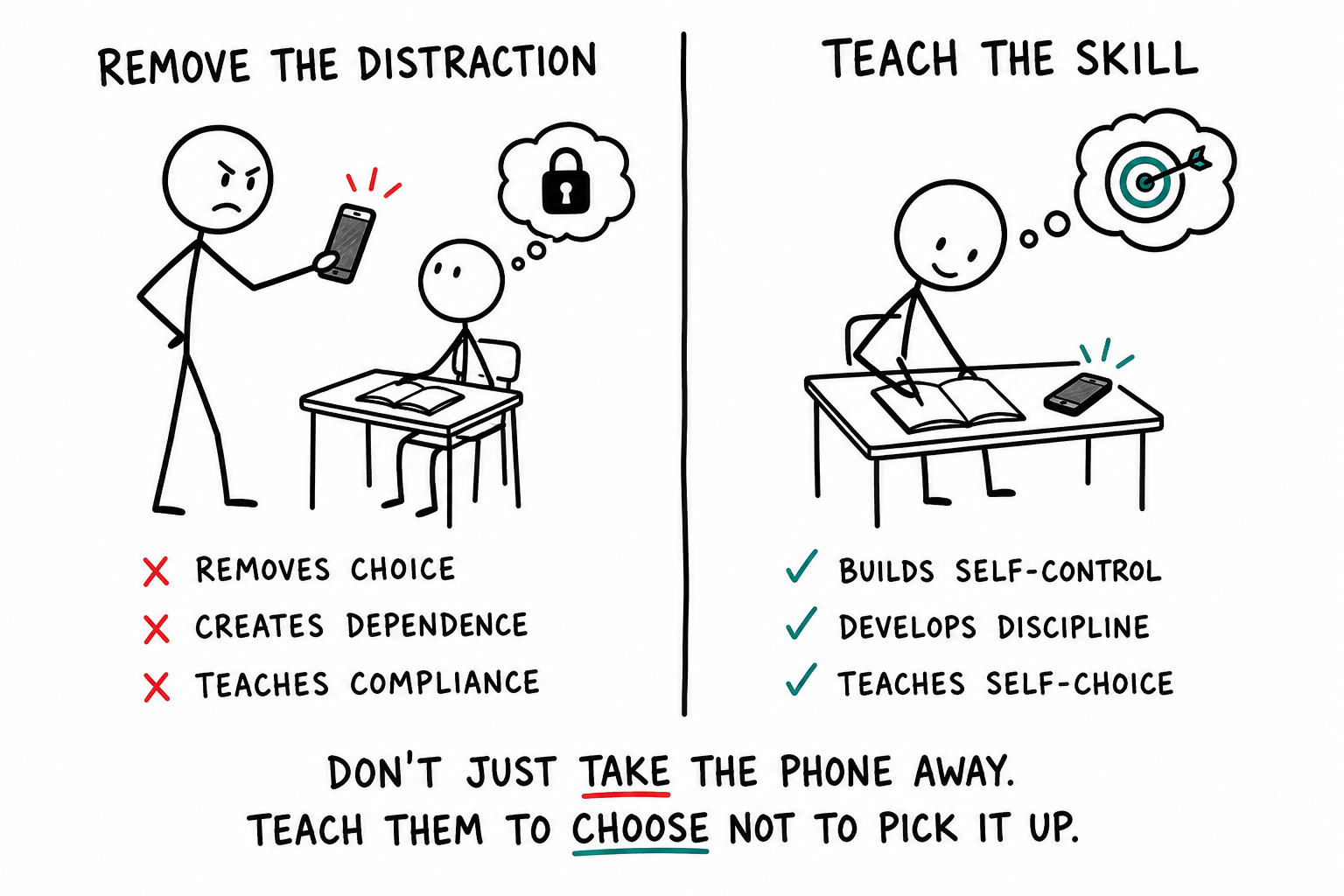
If students can only focus after we remove every distraction, we're teaching compliance—not self-control.
Phones are distracting.
Let's start there.
They buzz. They flash. They provide instant access to messages, games, social media, videos, friends and practically every other thing a teenager would rather be doing than solving an equation.
So the solution seems obvious.
Ban smartphones from classrooms.
Take the phone away and the distraction disappears.
Problem solved.
Except perhaps we have solved the wrong problem.
Because the goal of education shouldn't only be to create an environment in which students can concentrate.
It should also be to help students develop the ability to concentrate when the environment isn't perfect.
And that changes the question completely.
Taking the phone away doesn't teach discipline. It removes the need for discipline.
A Student Without a Phone Isn't Necessarily a Disciplined Student
Imagine two students studying mathematics.
The first student's phone has been confiscated. They have no access to TikTok, Snapchat, messages or games.
They complete their assignment.
The second student has their phone on the desk.
A notification appears.
They see it.
They want to check it.
But they decide:
Not now. I'll finish this first.
Both students completed the assignment.
But something very different happened inside their heads.
The first student didn't need to make a decision.
The environment made it for them.
The second student had to regulate their own behavior.
That is much closer to what we actually mean when we talk about self-discipline, self-control and self-regulated learning.
And those skills matter far beyond the classroom.
What Happens When School Ends?
This is the bigger problem with relying entirely on classroom phone bans.
Eventually, students leave the classroom.
They go home to study.
Or they go to university.
Or vocational education.
Or work.
And suddenly nobody is standing next to them confiscating their smartphone.
The phone is there.
So are YouTube, TikTok, Instagram, WhatsApp, games, streaming services and an endless internet designed to compete for their attention.
At the same time, the student is expected to manage deadlines, complete assignments, prepare for exams and organize their own life.
We spend years controlling the student's environment.
Then we suddenly expect the student to control themselves.
Where exactly were they supposed to learn how?
Compliance and Self-Discipline Are Not the Same Thing
This distinction matters.
Compliance means:
I don't use my phone because I'm not allowed to.
Self-discipline means:
I could use my phone, but I've decided not to right now.
Those behaviors may look identical from the teacher's desk.
But psychologically, they are very different.
One depends on external control.
The other increasingly depends on internal control.
Education needs both.
A seven-year-old cannot reasonably be expected to possess the same self-regulation as a seventeen-year-old. Teachers also need classrooms where teaching is actually possible.
Rules matter.
Boundaries matter.
Sometimes phones absolutely should be put away.
But there is an enormous difference between using restrictions as a temporary structure and treating restrictions as the final educational solution.
The goal should be to gradually transfer responsibility from the adult to the learner.
The Goal Shouldn't Be Unlimited Phone Use
This isn't an argument for letting thirty students scroll TikTok while a teacher desperately tries to explain algebra.
Nor is it an argument that every student should always have unrestricted access to their phone.
That would confuse freedom with education.
Instead, schools could treat digital self-regulation as a skill that needs to be taught and practiced.
We teach students how to manage money.
We teach them how to behave in traffic.
We teach them how to communicate.
We teach them how to evaluate information.
Why wouldn't we explicitly teach them how to manage the device that may compete for thousands of hours of their attention throughout their lives?
So What Could Schools Actually Do?
Simply saying "students should learn self-control" isn't enough.
Self-control needs structure, practice and feedback.
1. Create Phone-Free Periods Instead of Phone-Free Thinking
Teachers can establish clear periods when phones are not used.
For example:
For the next 25 minutes, phones stay face down. Then we'll take a five-minute break.
But instead of immediately collecting every device, students can be asked to manage the rule themselves.
The restriction still exists.
The difference is that the student participates in enforcing it.
That small distinction creates an opportunity to practice self-control.
2. Teach Students to Disable the Things Designed to Distract Them
Digital discipline isn't just about willpower.
Environment matters.
Students can be taught to disable unnecessary notifications, use Do Not Disturb or Focus modes, remove distracting apps from the home screen, use app timers, keep the phone out of immediate reach during demanding work, and create separate study and entertainment routines.
These are practical study skills for the smartphone era.
A student who learns how to intentionally configure their digital environment has gained a skill they can use long after leaving school.
3. Let Students Experience the Difference
Instead of merely telling students that phones damage concentration, turn it into an experiment.
Study for ten minutes with notifications enabled.
Then study for ten minutes with the phone silent and out of reach.
Afterward, compare.
How often did you look at the phone?
How many times did your attention shift?
How much work did you complete?
How difficult was it to return to the task?
Students can discover something much more powerful than:
Teacher says phones are bad.
They can discover:
My phone changes how I think.
That creates awareness.
And awareness makes deliberate behavior possible.
4. Make the Student Choose Where the Phone Goes
At the beginning of independent work, give students options.
Phone on the desk, face down.
Phone in the backpack.
Phone in a classroom storage area.
Then ask them to choose the environment in which they believe they will work best.
Afterward, ask whether their choice worked.
Now the conversation isn't merely about rules.
It's about metacognition:
What kind of learner am I?
What distracts me?
What environment helps me concentrate?
What should I change next time?
Those are extraordinarily valuable questions.
5. Gradually Increase Responsibility
Self-regulation doesn't have to be all or nothing.
Younger students may need strong external boundaries.
As students mature, those boundaries can gradually change.
The progression might look something like:
Adult controls the phone → student follows structured rules → student chooses a strategy → student manages their own attention.
That is scaffolding.
We already use the same principle throughout education.
At first, we provide support.
Then we gradually remove it.
Why should digital discipline be different?
Smartphones Can Also Be Learning Tools
There is another uncomfortable part of the phone-ban discussion.
The smartphone is simultaneously one of the greatest distractions students have ever encountered and one of the most powerful learning devices ever created.
A student can carry a calculator, dictionary, camera, translator, notebook, flashcard system, library, educational videos, AI, practice exercises and access to more information than any previous generation could have imagined.
All in one pocket.
The educational challenge isn't simply:
How do we keep students away from this device?
It's also:
How do we teach students to use this device intentionally?
Because the smartphone isn't disappearing when the school bell rings.
Schools Cannot Remove Every Distraction From Life
There is a broader educational principle here.
We shouldn't confuse removing a challenge with teaching someone to overcome it.
If a student struggles with time management, someone else managing every minute doesn't automatically teach time management.
If a student struggles with motivation, forcing them to work doesn't automatically teach motivation.
And if a student struggles with digital distraction, permanently removing the device doesn't automatically teach digital self-control.
External structure can be necessary.
But ultimately, education should help students become less dependent on that structure.
The destination is autonomy.
Maybe We Are Asking the Wrong Question
The phone debate is often framed as:
Should phones be allowed or banned in classrooms?
Perhaps that question is too simple.
A better question might be:
What do we want students to be capable of when nobody is there to take the phone away?
Because eventually, nobody will be.
And that's when the real test begins.
The student will have work to do.
The phone will be sitting beside them.
Nobody will confiscate it.
Nobody will give them detention.
Nobody will tell them to concentrate.
They will have to make the decision themselves.
That's why the goal shouldn't merely be teaching students to put their phones away.
The goal should be teaching them to choose not to pick them up.
And that is something no phone ban can teach on its own.