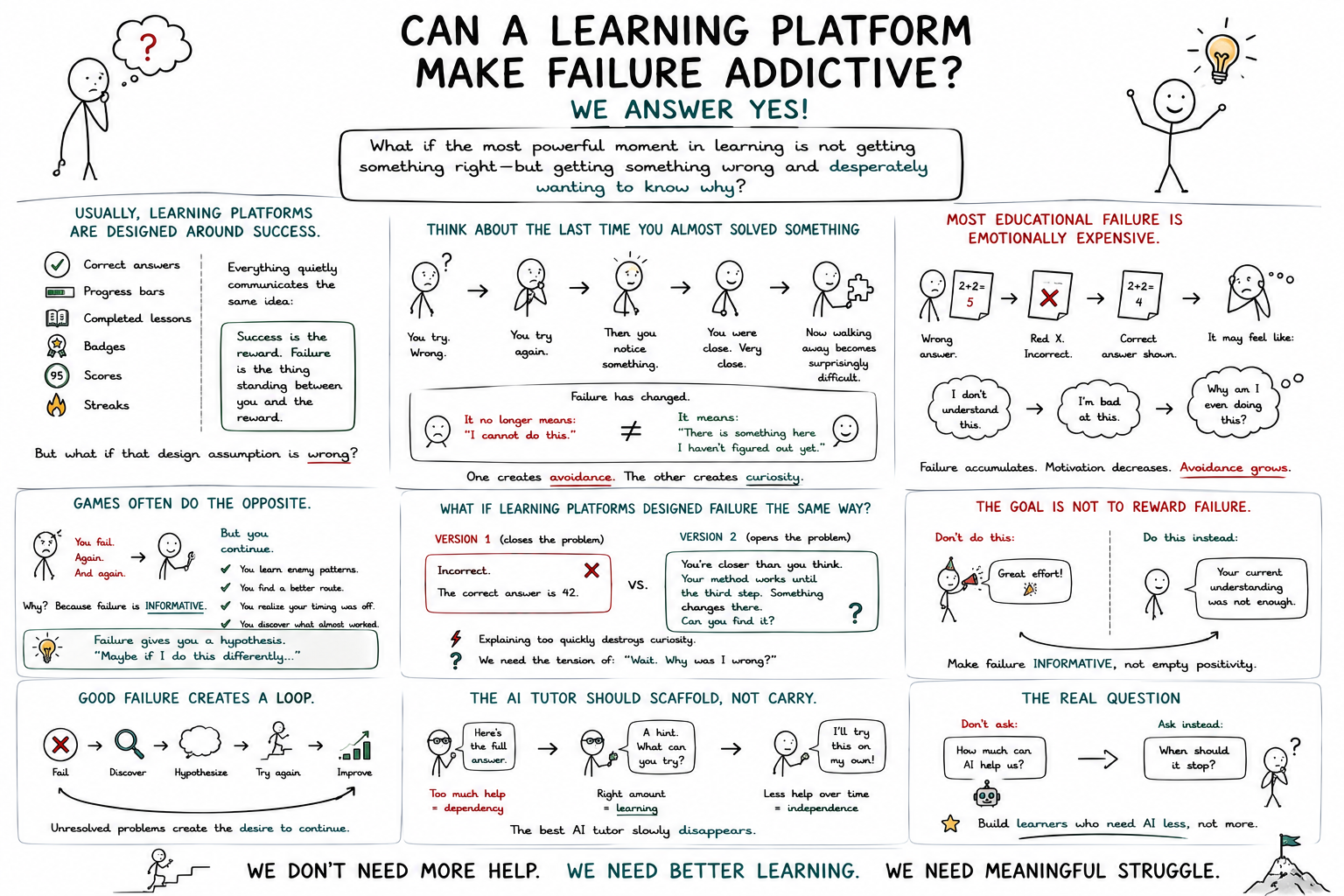
What if the most powerful moment in learning is not getting something right—but getting something wrong and desperately wanting to know why?
That sounds backwards.
Learning platforms are usually designed around success.
Correct answers.
Green checkmarks.
Progress bars.
Completed lessons.
Badges.
Scores.
Streaks.
Everything quietly communicates the same idea:
Success is the reward. Failure is the thing standing between you and the reward.
But what if that design assumption is wrong?
What if failure itself could become one of the strongest reasons to continue?
Not because failure feels good.
Not because we should celebrate every wrong answer.
And definitely not because we should manipulate students into endless screen time.
But because a well-designed failure can create something incredibly powerful:
an unresolved problem.
And unresolved problems are difficult to leave alone.
Think About the Last Time You Almost Solved Something
You try a puzzle.
Wrong.
You try again.
Still wrong.
Then suddenly you notice something.
You were close.
Very close.
Now walking away becomes surprisingly difficult.
Why?
Because failure has changed.
It no longer means:
“I cannot do this.”
It means:
“There is something here I haven't figured out yet.”
Those two experiences look almost identical from the outside.
In both cases, the person failed.
Psychologically, they are completely different.
One creates avoidance.
The other creates curiosity.
And that difference may be one of the most important design problems in education.
Most Educational Failure Is Emotionally Expensive
Imagine a student answering a mathematics question incorrectly.
What happens?
A red X appears.
Maybe the correct answer appears underneath.
Perhaps the platform says:
Incorrect. Try again.
From the system's perspective, this is perfectly logical.
The student was wrong.
The system informed them.
Job done.
But the student's brain isn't necessarily processing the event as neutral information.
It may be interpreting it as:
I don't understand this.
Then:
I'm bad at this.
Then:
I always struggle with this.
And eventually:
Why am I even doing this?
One wrong answer doesn't usually destroy motivation.
But failure accumulates.
And when every mistake feels like another piece of evidence against your ability, learning becomes emotionally expensive.
Eventually the rational response is avoidance.
Not because the student is lazy.
Because the experience keeps producing negative returns.
Games Often Do the Opposite
Now imagine a difficult game.
You fail.
Again.
And again.
And somehow you continue.
Why?
The game doesn't necessarily make failure pleasant.
Sometimes losing is incredibly frustrating.
But good games frequently make failure informative.
You discover that the enemy attacks from the left.
You learn that you jumped too early.
You realize there is another route.
You notice that your strategy almost worked.
Failure gives you a hypothesis.
And the hypothesis makes you want another attempt.
Maybe if I do this differently...
That sentence is enormously important.
Because once a learner starts thinking:
“Maybe if...”
failure has stopped being a verdict.
It has become an experiment.
What If Learning Platforms Designed Failure the Same Way?
Consider two responses to the exact same incorrect answer.
Version 1
Incorrect.
The correct answer is 42.
Version 2
You're closer than you think.
Your method works until the third step.
Something changes there.
Can you find it?
Same mistake.
Completely different experience.
The first closes the problem.
The second opens one.
And that may be the crucial distinction.
Modern learning systems are obsessed with explaining.
But sometimes explaining too quickly destroys curiosity.
If every failure immediately produces the full solution, the learner never experiences the tension of:
“Wait. Why was I wrong?”
And that tension can be incredibly valuable.
The Goal Is Not to Reward Failure
There is an obvious danger here.
Educational technology has developed a strange habit of turning everything into positive reinforcement.
Wrong answer?
Great effort! 🎉
Failed the entire exercise?
Amazing progress! ⭐
Clicked three buttons?
Achievement unlocked!
Students are not stupid.
Artificial positivity quickly becomes meaningless.
Failure should still communicate something real:
Your current understanding was not enough.
But that message can be followed by another:
Let's find out exactly why.
That is very different from pretending failure is success.
The goal should not be to remove the discomfort of failure.
The goal should be to convert that discomfort into forward motion.
The Most Important Question Might Be: What Happens Five Seconds After Failure?
We measure learning platforms in all kinds of ways.
Completion rate.
Correct-answer percentage.
Daily active users.
Lesson progress.
Time spent.
Test scores.
But perhaps one of the most interesting metrics would be:
What does the learner do immediately after being wrong?
Do they:
leave?
skip?
guess randomly?
ask for the answer?
open another app?
or voluntarily try again?
That moment tells us something profound about the experience.
Because motivation is easy when everything is going well.
The real test of a learning system begins when the learner fails.
Could We Measure a Failure-to-Retry Rate?
Imagine a metric:
Failure → Voluntary Retry Rate
A student answers incorrectly.
What percentage voluntarily attempt another meaningful solution?
That might tell us more about motivational design than a hundred engagement dashboards.
Now imagine going deeper.
Which types of feedback increase retry behavior?
Which explanations reduce it?
Does revealing the full answer immediately reduce curiosity?
Does showing that the learner was almost correct increase persistence?
Does asking a targeted question work better than giving an explanation?
Does showing progress toward understanding change the emotional meaning of failure?
Suddenly failure stops being merely an outcome.
It becomes a design surface.
AI Makes This Much More Interesting
Traditional educational software had limited options.
Question.
Answer.
Correct or incorrect.
Maybe a predefined hint.
Maybe an explanation.
AI changes this dramatically.
Because the system can potentially ask:
Why did this particular learner fail?
Not just:
Was the answer wrong?
Those are very different questions.
Imagine two students producing the same incorrect answer.
Student A misunderstood the entire concept.
Student B understands the concept perfectly but made one arithmetic mistake.
Giving both the same explanation is terrible teaching.
Yet that is exactly what static systems often do.
An AI-driven platform can potentially identify the difference.
And then failure becomes useful data.
A wrong answer can reveal:
a missing prerequisite,
a misconception,
an incorrect mental model,
careless execution,
poor reading comprehension,
guessing,
overconfidence,
or simply a question that was too difficult.
That means every failure can change what happens next.
Failure Becomes Navigation
This may be the bigger idea.
What if learning is not a straight path?
What if it is a map that is gradually revealed through attempts?
You try something.
You succeed.
Good.
Move forward.
You fail.
Also useful.
Now we know something about the map.
Perhaps we need to go sideways.
Perhaps backwards.
Perhaps deeper.
Perhaps we need a different explanation.
Perhaps we discovered a weakness that has been hidden for years.
In that model, failure isn't an interruption to learning.
Failure is how the system learns where to take you.
That changes everything.
This Could Be One of APUOPE's Most Important Design Principles
APUOPE should not simply become another platform that celebrates correct answers.
There are already thousands of systems capable of asking questions and displaying green checkmarks.
The opportunity is elsewhere.
When a learner gets something wrong, APUOPE should become more interesting.
The system could ask:
What made you choose that answer?
Or:
Your answer suggests you understand X, but not Y. Want to test that?
Or:
You would actually be correct under one different assumption. Can you figure out which one?
Or:
This mistake usually happens when one earlier concept is missing. Let's check whether that's the problem.
Now the wrong answer isn't the end of the interaction.
It is the beginning of diagnosis.
And diagnosis creates personalization that actually matters.
Not:
“Here is your personalized learning dashboard.”
But:
“I think I know exactly why you're stuck.”
That is valuable.
What If Failure Unlocks the Most Interesting Content?
Here's another possibility.
Most platforms unlock rewards after success.
What if failure unlocks discovery?
A surprising example.
A visual explanation.
A contradiction.
A simpler challenge.
A hidden connection.
A real-world application.
A question specifically designed around the mistake you just made.
Failure could trigger something the learner wants to see.
Not as a consolation prize.
As a consequence of discovering something interesting about their thinking.
The behavioral loop becomes:
Attempt → Failure → Curiosity → Discovery → New Attempt
And eventually:
Understanding.
Compare that with the loop many students already know:
Attempt → Failure → Shame → Avoidance
The difference is not the failure.
The difference is what the system does with it.
But Should Learning Be “Addictive”?
The word deserves scrutiny.
We probably should not build educational systems whose objective is maximizing compulsive use.
Education does not need the same engagement model as social media.
More screen time is not automatically better.
More clicks are not learning.
More sessions are not mastery.
If a student understands something in ten minutes and leaves, that can be a better outcome than keeping them engaged for an hour.
So perhaps addictive is the wrong product goal.
But it is still a useful provocation.
Because there is one behavior we might genuinely want to make difficult to resist:
closing an unanswered question.
That kind of pull is different.
It doesn't come from infinite scrolling.
It comes from curiosity.
You don't continue because the platform keeps feeding you stimulation.
You continue because your brain wants resolution.
The Best Learning Platforms May Not Minimize Failure
This leads to an uncomfortable idea.
A platform with fewer wrong answers is not necessarily a better learning platform.
If learners are always succeeding, perhaps the material is too easy.
Perhaps the system is optimizing for satisfaction instead of growth.
Perhaps students are practicing what they already know.
Real learning should occasionally produce:
Wait. I don't understand this.
That moment is valuable.
Because now something invisible has become visible.
And once the gap becomes visible, the learner can work on it.
The question is whether the platform makes that discovery feel like defeat—
or opportunity.
AI Is Making Answers Cheap
This makes the entire discussion more important.
For most of history, getting the answer had significant value.
Information was scarce.
Experts were scarce.
Teachers were scarce.
Explanations were scarce.
Now AI can produce answers almost instantly.
Ask.
Receive explanation.
Ask again.
Receive another explanation.
That means the value of simply providing answers is falling.
The more interesting problem is increasingly:
What question should this learner face next?
And perhaps even more importantly:
What mistake should we explore next?
Because AI does not merely allow educational platforms to answer questions.
It allows them to react intelligently to misunderstanding.
That might become far more valuable.
Maybe the Future of Learning Is Built Around Better Failure
Think about what a great teacher often does.
A student answers incorrectly.
The teacher doesn't immediately say:
Wrong. The answer is B.
They pause.
They notice something.
They ask:
Why do you think that?
The student explains.
Now the teacher sees the misconception.
Then comes another question.
And another.
Suddenly the student realizes the problem themselves.
Ohhh.
That moment is powerful because the student didn't merely receive information.
They experienced the correction of their own thinking.
AI potentially allows learning platforms to create millions of moments like that.
Not by pretending failure doesn't matter.
But by treating it as valuable information.
So Can Failure Become Addictive?
Perhaps.
But only if we understand what we actually want the learner to crave.
Not failure itself.
Not rewards.
Not points.
Not streaks.
Not even necessarily success.
We want them to crave resolution.
The learner encounters something they don't understand.
Their brain says:
I need to figure this out.
They try.
They fail.
The system reveals just enough information to make the gap clearer.
They try again.
And eventually:
Oh. Now I get it.
Then something remarkable happens.
The emotional meaning of failure begins to change.
It stops saying:
You are bad at this.
And starts saying:
You just found the next thing you can learn.
That might be one of the most powerful transformations an educational platform can create.
So maybe the question isn't:
Can we make failure addictive?
Maybe it's:
Can we make not understanding something so interesting that the learner doesn't want to walk away until they do?
If we can—
we may not need to make studying addictive at all.
Curiosity will do the job for us.